Facing ISO 9001 audit findings is common, whether you’re preparing for a certification audit, surveillance audit, or internal audit. Even mature quality management systems can receive findings due to documentation gaps, weak controls, or ineffective implementation.
Understanding common ISO 9001 nonconformities can help organizations prevent repeat issues, improve audit performance, and strengthen their Quality Management System (QMS).
In this guide, we cover:
- The most common ISO 9001 audit findings
- How to avoid nonconformities
- Relevant ISO 9001 clauses linked to each finding
- Practical audit preparation tips
What Is an ISO 9001 Audit Finding?
An ISO 9001 audit finding is an issue identified during an audit where evidence shows a gap, weakness, or nonconformity against ISO 9001 requirements or your own internal procedures.
Types of Audit Findings
1. Nonconformity
A failure to meet a requirement.
Example: Training records required by procedure are missing.
2. Observation
A concern that could become a nonconformity if left unresolved.
3. Opportunity for Improvement (OFI)
A suggestion to improve effectiveness, even if there is no violation.
What Are the Most Common ISO 9001 Audit Findings?
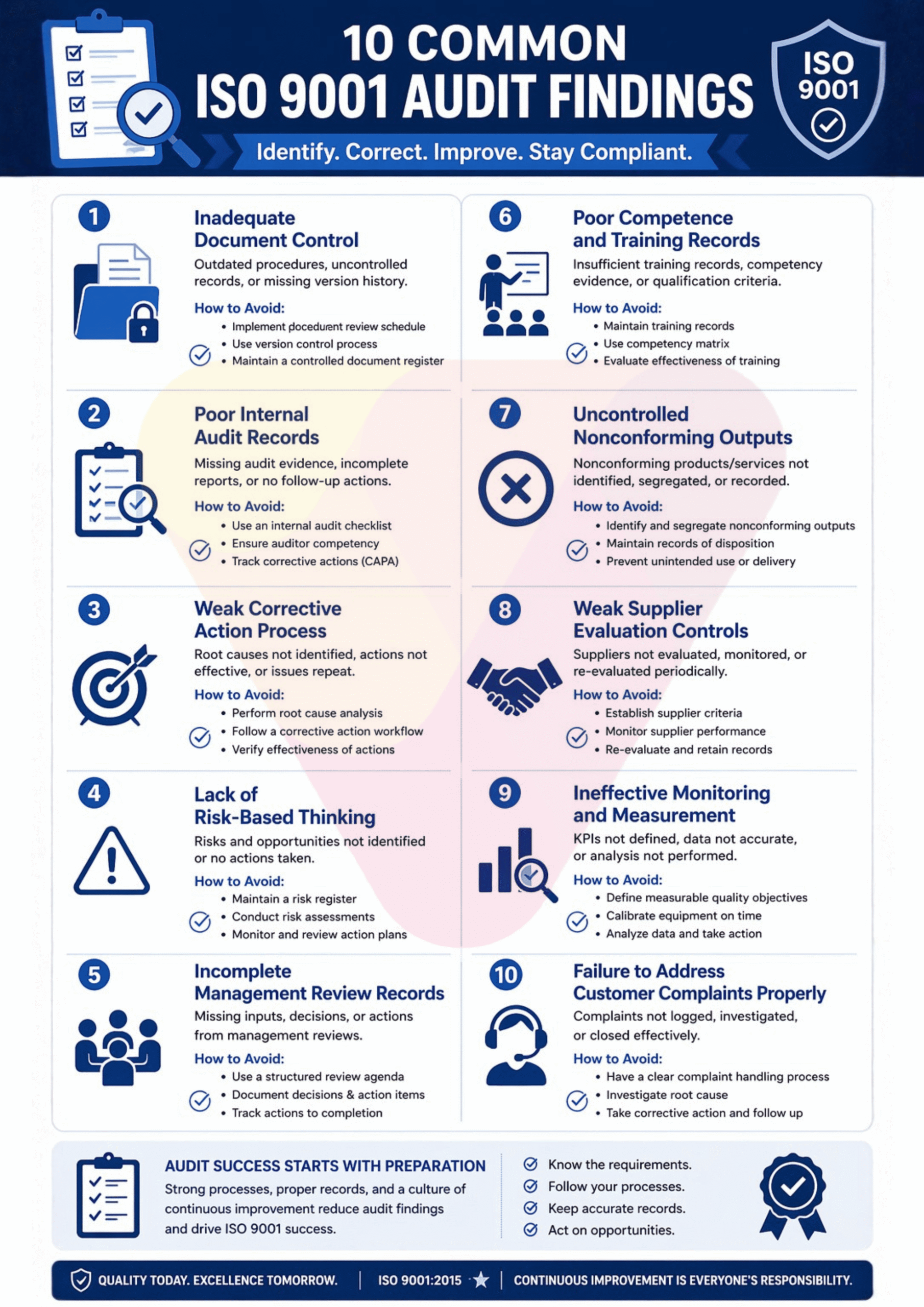
The most common ISO 9001 audit findings include:
- Inadequate document control
- Poor internal audit records
- Weak corrective action processes
- Lack of risk-based thinking
- Incomplete management reviews
- Poor competence records
- Uncontrolled nonconforming outputs
- Weak supplier evaluations
- Ineffective monitoring and measurement
- Poor complaint handling
1. Inadequate Document Control
Common Issue
One of the most frequent ISO 9001 audit findings is poor document control.
Auditors often find: Outdated procedures in use
- Uncontrolled forms
- Missing revision history
- Employees using obsolete work instructions
Related clause: ISO 9001 Documented Information
How to Avoid It
Implement:
- Document review schedule
- Version control process
- Master document register
- Approval workflow before release
2. Poor Internal Audit Records
Common Issue
Internal audits are often performed, but evidence is weak.
Common findings:
- Missing audit reports
- No objective evidence recorded
- Incomplete corrective action follow-up
How to Avoid It
Use an ISO 9001 internal audit checklist and ensure:
- Audit plans are documented
- Evidence is recorded
- Findings are categorized
- Follow-up actions are tracked
3. Weak Corrective Action Process
Common Issue
Organizations fix symptoms, not root causes.
Auditors often identify:
- Repeated issues
- No root cause analysis
- Corrective actions closed without verification
Related clause: ISO 9001 Clause 10.2
How to Avoid It
Use:
5 Whys analysis
- Fishbone analysis
- Corrective action workflow
- Effectiveness verification
- This is critical to reduce repeat ISO 9001 nonconformities.
4. Lack of Risk-Based Thinking
Common Issue
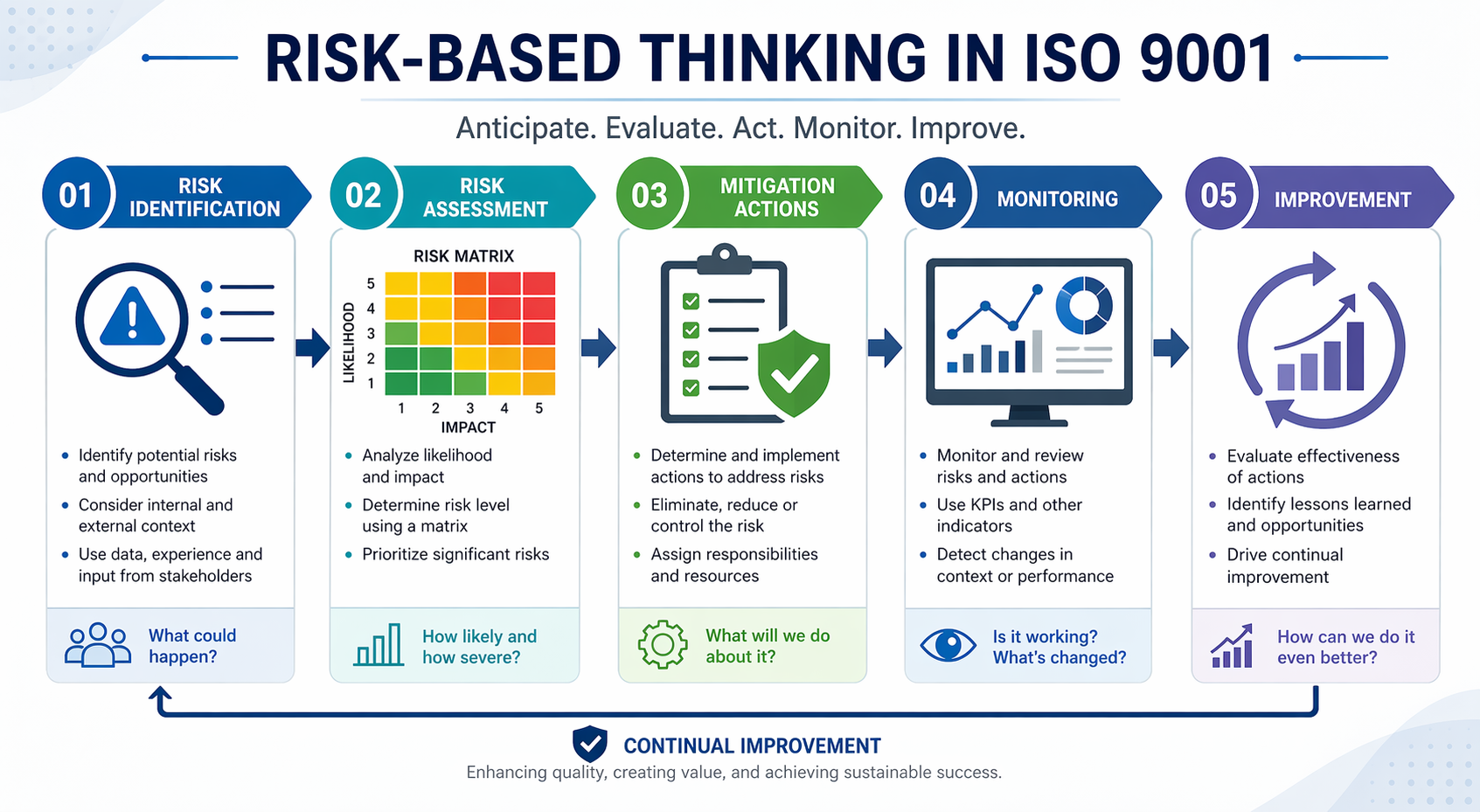
Many organizations struggle with ISO 9001 Clause 6.
Common findings:
- Risks not identified
- No risk register
- Actions not linked to risks
How to Avoid It
Implement:
- Risk register
- Risk assessments
- Action plans
- Periodic risk reviews
5. Incomplete Management Review Records
Common Issue
Auditors often find management reviews missing required inputs:
- Audit results
- Customer feedback
- Process performance
- Improvement actions
How to Avoid It
Use a structured management review agenda aligned to ISO requirements.
Maintain:
- Meeting minutes
- Attendance records
- Action tracking logs
6. Poor Competence and Training Records
Common Issue
Training may occur, but evidence is missing.
Common audit findings include:
- No competency matrix
- Missing training records
- Undefined qualification criteria
Related clause: ISO 9001 Clause 7.2
How to Avoid It
Maintain:
- Skills matrix
- Training records
- Competency evaluations
7. Uncontrolled Nonconforming Outputs
Common Issue
Products or services that fail requirements are not properly controlled.
Auditors may find:
- No segregation of defective products
- No disposition records
- Rejected products released accidentally
Related clause: ISO 9001 Clause 8.7
How to Avoid It
Implement:
- Nonconformance logs
- Quarantine controls
- Rework authorization process
8. Weak Supplier Evaluation Controls
Common Issue
Supplier controls are often poorly defined.
Common findings:
- No approved supplier criteria
- No supplier performance monitoring
- Missing reevaluation records
How to Avoid It
Use:
- Supplier approval process
- Supplier scorecards
- Periodic supplier reviews
9. Ineffective Monitoring and Measurement
Common Issue
Organizations collect data but fail to use it effectively.
Auditors may identify:
- Undefined KPIs
- Missing calibration records
- Poor performance analysis
How to Avoid It
Define:
- Quality objectives
- Performance indicators
- Monitoring methods
10. Failure to Address Customer Complaints Properly
Common Issue
Customer complaints are handled informally with no system.
Common findings:
- Complaints not logged
- Root causes not investigated
- No corrective action taken
How to Avoid It
Create:
- Complaint handling procedure
- Complaint register
- CAPA workflow
ISO 9001 Clauses Linked to Common Findings
ISO 9001 Clause 6
Risk-based thinking
ISO 9001 Clause 7.2
Competence
ISO 9001 Clause 8.7
Control of nonconforming outputs
ISO 9001 Clause 10.2
Corrective action
How to Prepare for Your Next ISO 9001 Audit?
Before your next audit:
✔ Review controlled documents
✔ Conduct internal audit
✔ Close outstanding corrective actions
✔ Review risks and opportunities
✔ Verify competence records
✔ Check supplier evaluations
✔ Review customer complaints
✔ Conduct management review
This simple ISO 9001 audit preparation checklist can reduce findings significantly.
FAQs
What are the most common ISO 9001 audit findings?
The most common findings include document control issues, weak corrective action processes, poor training records, supplier control gaps, and customer complaint handling failures.
What is the difference between major and minor nonconformity?
Major nonconformity:
- Systemic failure or serious breakdown.
Minor nonconformity:
- Isolated issue that does not threaten the entire QMS.
How can I reduce ISO 9001 audit findings?
You can reduce findings by:
- Conducting strong internal audits
- Using corrective action properly
- Maintaining records
- Applying risk-based thinking
- Training employees
What clause causes the most ISO 9001 findings?
Commonly cited clauses include:
- Clause 6
- Clause 7.2
- Clause 8.7
- Clause 10.2
Do internal audits help prevent certification findings?
Yes. Strong internal audits identify issues before certification auditors do.
Conclusion
Most ISO 9001 audit findings are not random—they’re largely preventable.
In many cases, they stem from a few recurring issues:
- Weak or inconsistent implementation
- Poor or incomplete records
- Inadequate operational controls
- Ineffective corrective actions
By understanding these common nonconformities and adopting a proactive approach to audit preparation, organizations can significantly reduce risk, improve compliance, and strengthen their Quality Management System (QMS).
Ready to improve your audit performance?
Build stronger auditing skills with VERGER Academy’s ISO 9001 Internal Auditor Course and learn how to effectively identify, prevent, and manage audit findings.
For more insights, explore our other blogs such as the ISO 45001 safety audit checklist and the benefits of ISO training.