
ISO 9001 in Manufacturing helps companies improve product quality, reduce production errors, streamline operations, and enhance customer satisfaction through an internationally recognized Quality Management System (QMS).
In today’s competitive manufacturing industry, maintaining consistent quality is essential for business success. Whether producing automotive parts, electronics, textiles, or industrial equipment, manufacturers must meet strict quality and customer requirements.
ISO 9001 provides a structured framework that helps manufacturing companies improve efficiency, standardize processes, minimize defects, and ensure continuous improvement across operations.
In this article, we will explore the importance, benefits, key requirements, and implementation process of ISO 9001 for manufacturing industries.
Overview of ISO 9001
ISO 9001 is an internationally accepted standard issued by the International Organization for Standardization (ISO). It specifies the requirements for establishing a robust Quality Management System (QMS) that helps organizations consistently deliver products and services that meet customer and regulatory expectations.
The standard is built on a foundation of key quality management principles, including:
Customer focus and satisfaction
Strong leadership commitment
Process-oriented management approach
Continuous improvement mindset
Decision-making based on data and evidence
Effective management of relationships with suppliers and stakeholders
Unlike product-based standards, ISO 9001 does not define the characteristics of a product or service. Instead, it focuses on how an organization should structure and control its processes to ensure consistent quality output.
Because of this process-driven approach, ISO 9001 is applicable across all industries. However, it is especially important in manufacturing, where consistent process control directly determines product quality, efficiency, and customer satisfaction.
Learn More: What is ISO 9001:2015: The Complete Guide to Quality Management Systems
Why ISO 9001 is Important in the Manufacturing Industry?
Manufacturing companies operate in environments where small mistakes can lead to major losses—defective products, wasted raw materials, customer complaints, or even legal issues.
ISO 9001 helps manufacturers by creating a structured and controlled system for production and quality management.
1. Ensures Consistent Product Quality
ISO 9001 ensures that every product is manufactured using standardized processes. This reduces variation and improves consistency across production batches.
2. Improves Production Efficiency
By defining clear workflows and responsibilities, ISO 9001 reduces confusion, delays, and unnecessary rework on the production floor.
3. Reduces Waste and Cost
Better process control leads to fewer defects, lower rejection rates, and reduced material waste—directly improving profitability.
4. Enhances Customer Satisfaction
Customers expect reliable and defect-free products. ISO 9001 helps companies meet these expectations consistently.
5. Improves Global Market Access
Many international buyers and government contracts require ISO 9001 certification as a basic eligibility criterion.
Key Requirements of ISO 9001 in Manufacturing
To implement ISO 9001, manufacturing companies must establish a structured Quality Management System. Key requirements include:
1. Process Control in Production
Every stage of production must be clearly defined, monitored, and controlled to ensure consistent output.
2. Documentation of Procedures
Companies must maintain documented information such as:
Standard Operating Procedures (SOPs)
Work instructions
Quality manuals
Process flow charts
3. Quality Inspection and Testing
Regular inspection of raw materials, in-process production, and final products is required to identify defects early.
4. Supplier Quality Management
Manufacturers must ensure that suppliers meet defined quality standards to avoid raw material issues.
5. Equipment Calibration and Maintenance
Machines and tools must be regularly calibrated and maintained to ensure accurate production results.
6. Non-Conformance Management
Any defective product or process failure must be recorded, analyzed, and corrected using a structured approach.
7. Continuous Improvement
Companies must continuously improve processes using the PDCA cycle:
Plan
Do
Check
Act
Benefits of ISO 9001 for Manufacturing Companies
ISO 9001 provides both operational and strategic advantages for manufacturers.
Business Benefits
- Improved product quality
- Higher customer trust
- Increased sales opportunities
- Better brand reputation
Operational Benefits
- Streamlined production processes
- Reduced errors and rework
- Improved employee productivity
- Better resource utilization
Financial Benefits
- Reduced operational costs
- Lower rejection and scrap rates
- Improved profitability
Market Benefits
- Eligibility for international contracts
- Easier entry into export markets
- Competitive advantage in tenders
In many industries, ISO 9001 certification is not optional—it is a requirement to do business.
Step-by-Step ISO 9001 Implementation in Manufacturing
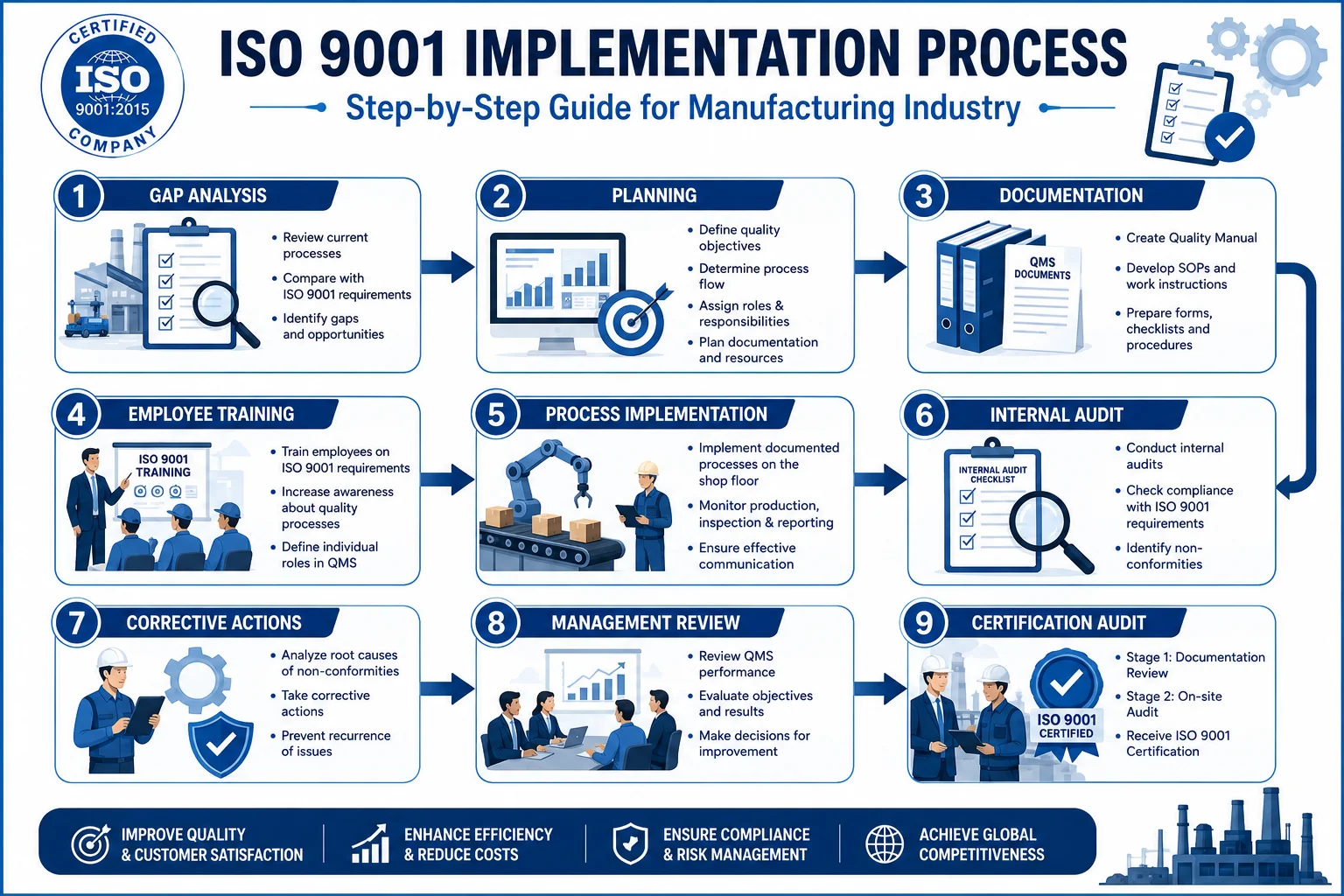
Implementing ISO 9001 requires a structured approach. Below is a practical step-by-step guide:
Step 1: Gap Analysis
The first step is to compare your current processes with ISO 9001 requirements. This helps identify missing areas in your quality system.
Step 2: Planning the Quality Management System
Define:
- Quality objectives
- Process flow
- Roles and responsibilities
- Documentation requirements
This step builds the foundation of the QMS.
Step 3: Documentation Development
Develop necessary documents such as:
- Quality Manual
- SOPs for production
- Work instructions
- Inspection checklists
- Quality policies
Proper documentation ensures consistency.
Step 4: Employee Training and Awareness
Employees must be trained on:
- ISO 9001 requirements
- Quality procedures
- Their roles in the system
Without training, implementation will not succeed.
Step 5: Implementation of Processes
All documented procedures must be implemented on the shop floor, including production, inspection, and reporting systems.
Step 6: Internal Audit
Internal audits are conducted to check compliance and identify non-conformities. This helps prepare for the certification audit.
Step 7: Corrective Actions
Any issues found during audits must be corrected through a structured corrective action process.
Step 8: Management Review
Top management reviews the system performance and ensures it aligns with business goals.
Step 9: Certification Audit
An external certification body performs:
Stage 1 Audit (Documentation review)
Stage 2 Audit (On-site evaluation)
If successful, ISO 9001 certification is granted.
Common Challenges in ISO 9001 Implementation
Many manufacturing companies face challenges during implementation:
1. Lack of Employee Awareness
Employees may not understand ISO requirements, leading to poor execution.
2. Poor Documentation Practices
Incomplete or outdated documentation can lead to audit failures.
3. Resistance to Change
Employees may resist new processes and systems.
4. Weak Internal Audits
Ineffective audits fail to detect system gaps early.
5. Lack of Continuous Improvement
Companies often implement ISO but fail to maintain improvement systems.
These challenges can be avoided with proper training and leadership commitment.
How ISO Training Helps Manufacturing Companies?
ISO training plays a critical role in successful implementation.
Internal Auditor Training
- Helps identify process gaps
- Ensures compliance
- Prepares teams for audits
Lead Auditor Training
- Builds leadership capability
- Helps manage audit systems
- Improves decision-making
Implementation Training
- Guides full setup of QMS
- Reduces certification failure risks
- Improves efficiency from day one
Proper training ensures ISO 9001 is not just a certificate, but a working system
Conclusion
ISO 9001 is a powerful quality management system that transforms how manufacturing companies operate. It ensures consistent product quality, reduces operational waste, and improves overall efficiency.
More importantly, it builds trust with customers and opens doors to global markets.
However, successful implementation requires more than documentation—it requires proper training, commitment, and continuous improvement.
For manufacturing companies aiming to grow in competitive markets, ISO 9001 is not just a standard—it is a business necessity.

Pingback: Major vs Minor Nonconformity: How Should an Auditor Decide?