
Spend a little time around ISO 9001 audits and a pattern shows up. The organizations that
struggle are rarely short of documents. They are short of shared thinking. Their procedures
exist, but the people behind them do not agree on what quality is for, who it serves, or how it
gets better.
That shared thinking is exactly what the quality management principles capture. They are
seven short ideas that sit behind every clause of ISO 9001:2015. Auditors rely on them,
trainers teach them, and well-run companies live by them, often without ever calling them by
name. Yet many people memorize the list for an exam and never put it to work.
This guide is written to change that. In plain language, you will see what each principle
means, how to apply it step by step, what it looks like in a real workplace, and which
mistakes lead to audit findings. It is written for quality managers preparing for certification,
business owners in Dubai and across the UAE who want to understand what ISO 9001 truly
asks for, and students beginning their journey toward becoming auditors.
In this guide you will learn
- What the 7 quality management principles are and where they come from
- How to apply each principle, with practical steps and example scenarios
- How the principles link to ISO 9001:2015 clauses
The most common mistakes to avoid, plus answers to frequent questions
| Quick answer: The seven quality management principles are customer focus, leadership, engagement of people, process approach, improvement, evidence-based decision making, and relationship management. They come from ISO 9000:2015 and form the foundation of ISO 9001:2015. Following them helps an organization deliver consistent quality, satisfy customers, and keep improving. |
What Are Quality Management Principles?
Quality management principles (QMPs) are seven fundamental beliefs about how organizations achieve lasting quality. They are not rules you can pass or fail. They are the thinking behind the rules.
The International Organization for Standardization (ISO) published them in ISO 9000:2015, the standard that defines quality management vocabulary and fundamentals.
The requirements in ISO 9001:2015 are built on these principles. Earlier versions of the ISO 9000 family listed eight principles. The 2015 revision reduced them to seven and merged “system approach to management” into the process approach.
A simple way to remember it: the principles explain the why, and the ISO 9001 clauses spell out the what you must do.
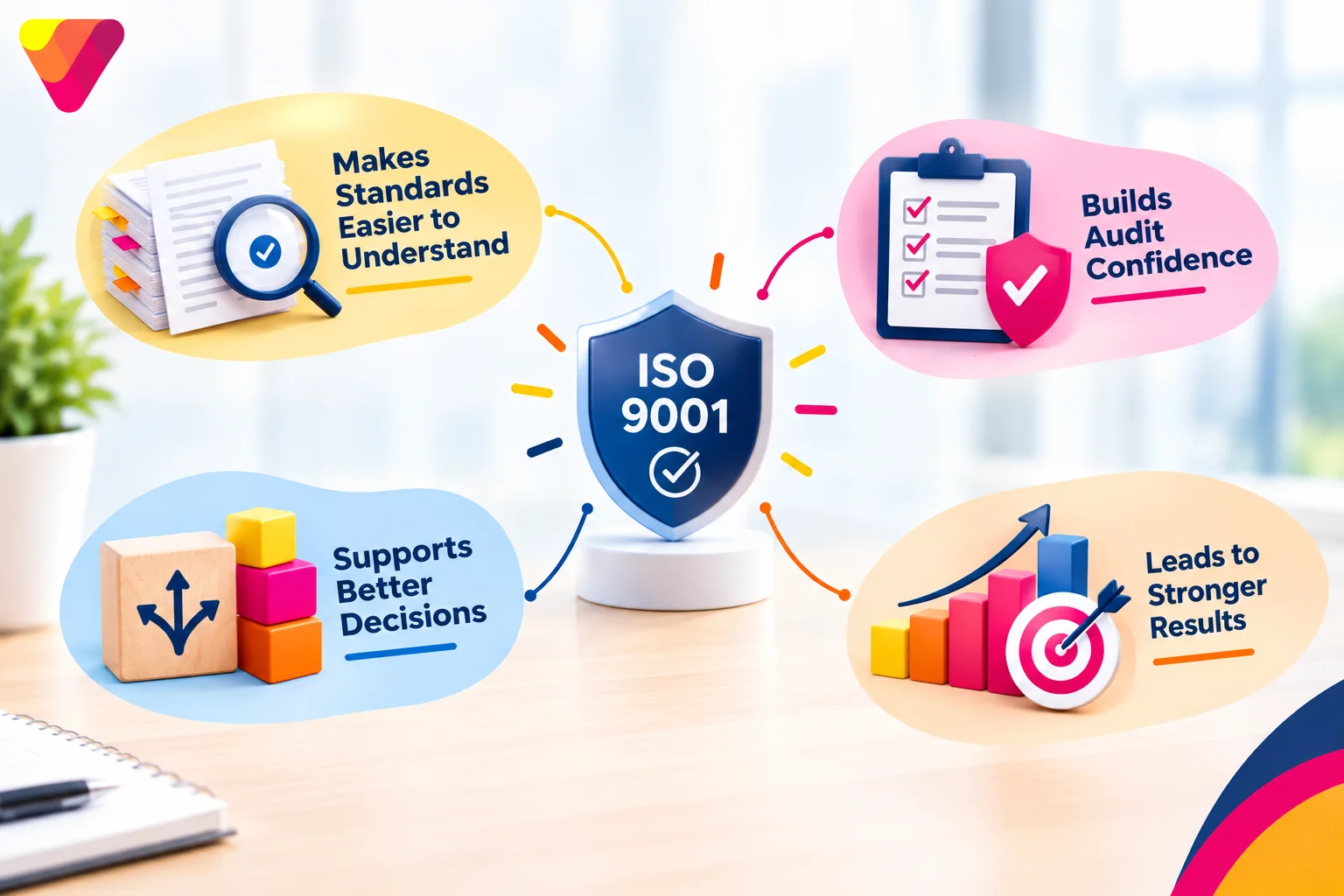
Why Do Quality Management Principles Matter?
They make ISO 9001 easier to understand. Once you see the intent, the clauses stop feeling like paperwork.
They guide audits. Auditors look for evidence that the principles are actually working, not only that documents exist.
They help decisions. When two options conflict, the principles give you a way to choose.
They improve results. Organizations that live by them tend to see fewer complaints, less rework, and steadier performance.
The 7 Principles at a Glance
| # | Principle | In one sentence |
| 1 | Customer focus | Understand customer needs and aim to meet and exceed them |
| 2 | Leadership | Leaders set direction and create the conditions for quality |
| 3 | Engagement of people | Competent, motivated people at every level deliver quality |
| 4 | Process approach | Manage activities as connected processes, not isolated tasks |
| 5 | Improvement | Keep improving, always |
| 6 | Evidence-based decision making | Decide using data, not guesses |
| 7 | Relationship management | Manage relationships with suppliers and other interested parties |
Principle 1: Customer Focus
What it means: The main aim of quality management is to meet customer requirements and try to go beyond what customers expect. Success depends on earning and keeping customer trust.
Why it matters: Customers decide whether your business continues. A product can meet every internal specification and still fail if it does not solve the customer’s problem.
How to apply it?
• Identify who your customers are, including internal customers such as the next department in your process.
• Collect feedback through surveys, complaints, repeat orders, and direct conversations.
• Turn what you learn into measurable targets, such as on-time delivery or defect rates.
• Share customer feedback with the teams who can act on it.
| Example scenario: A catering company in Dubai notices repeat complaints about late deliveries to corporate offices. By tracking delivery times and talking to clients, it finds that orders are packed on time but dispatch is slow. Fixing the dispatch step lifts satisfaction without changing the menu at all. |
Common mistake: Treating customer focus as a satisfaction survey sent once a year.
Principle 2: Leadership
What it means: Leaders at every level set a clear purpose and direction, and create an environment where people want to work toward quality goals.
Why it matters: Quality programs fail quickly when top management treats them as someone else’s job. People copy what leaders prioritize.
How to apply it?
• Write a quality policy that reflects what the business actually stands for, then make sure staff can explain it in their own words.
• Set quality objectives that connect to business goals.
• Give the quality system real resources: time, budget, and people.
• Take part in management reviews and act on the outcomes.
| Example scenario: A construction firm’s general manager attends monthly quality reviews, asks about open corrective actions, and approves training budgets. Site supervisors take the system seriously because the leader visibly does. |
Common mistake: Signing the quality policy and then disappearing from the process.
Principle 3: Engagement of People
What it means: Competent, empowered, and engaged people at all levels are essential to delivering value. People need to understand their role and feel responsible for results.
Why it matters: Procedures do not produce quality. People following (and improving) them do.
How to apply it?
• Define the competence each role needs and check that staff have it.
• Train people on what they do and why it matters.
• Encourage suggestions and recognize useful ones.
• Make it safe to report problems early.
| Example scenario: A food packaging team is encouraged to flag near-misses without blame. A line operator reports that labels sometimes stick poorly. The issue is fixed before any mislabeled product reaches a customer. |
Common mistake: Training once at induction and never revisiting competence.
Principle 4: Process Approach
What it means: Results are more consistent and predictable when activities are understood and managed as interrelated processes that work together as one system.
Why it matters: Most quality problems happen at the handoffs between teams, not inside one team’s work.
How to apply it?
- Map your key processes: sales, purchasing, production or service delivery, inspection, and delivery.
- For each process, define inputs, outputs, owner, resources, risks, and performance measures.
- Look at how processes link, because a delay in one flows into the next.
- Monitor each process using simple indicators.
| Example scenario: A trading company sees frequent order errors. Mapping the order-to-delivery process shows that sales notes are retyped three times between teams. Introducing one shared order form removes most errors. |
Common mistake: Drawing process maps for the audit and never using them to manage the work.
Principle 5: Improvement
What it means: Successful organizations keep improving. That means reacting to problems, but also looking for opportunities before problems appear.
Why it matters: Customer expectations, technology, and competition keep moving. Standing still means falling behind.
How to apply it?
- Use root cause analysis to fix the cause of problems, not just the symptom.
- Run internal audits and act on the findings.
- Set improvement objectives and review them regularly.
- Try small, low-risk changes and keep what works.
- Use the Plan-Do-Check-Act (PDCA) cycle.
| Example scenario: A service team finds that 30 percent of support tickets are about the same unclear invoice line. Rewriting the invoice format reduces tickets and frees staff time. |
Common mistake: Closing audit findings with a quick correction while ignoring the root cause. For more on this, see our guide on what a nonconformity is in ISO audits.
Principle 6: Evidence-Based Decision Making
What it means: Decisions based on analyzing data and information are more likely to give the results you want.
Why it matters: Opinions are fast but unreliable. Data helps you find the true cause of an issue and check whether a fix worked.
How to apply it?
- Decide which measures matter, such as defect rates, complaint trends, delivery performance, and audit results.
- Make sure the data is accurate and collected the same way each time.
- Review data in management meetings, not only at audit time.
- Check results after a change to confirm it helped.
| Example scenario: A manager believes late shipments come from one carrier. Delivery records show most delays start in the warehouse. Resources go to the right place. |
Common mistake: Collecting plenty of data but never reviewing it.
Principle 7: Relationship Management
What it means: For lasting success, an organization manages its relationships with interested parties, especially suppliers, partners, and customers.
Why it matters: Your quality depends partly on what others deliver to you. A weak supplier becomes your quality problem.
How to apply it?
- Identify your interested parties and what they expect.
- Evaluate and select suppliers using clear criteria.
- Share requirements and expectations in writing.
- Review supplier performance and give feedback.
- Build long-term relationships with critical suppliers.
| Example scenario: A manufacturer shares its quality requirements with a key supplier and reviews delivery and defect data together every quarter. Incoming rejections fall over time. |
Common mistake: Choosing suppliers only on price.
How the Principles Connect to ISO 9001 Clauses?
| Principle | Where it appears in ISO 9001:2015 (examples) |
| Customer focus | Clauses 5.1.2, 8.2, 9.1.2 |
| Leadership | Clauses 5.1, 5.2, 5.3 |
| Engagement of people | Clauses 7.1.2, 7.2, 7.3, 7.4 |
| Process approach | Clauses 4.4, 8.1 |
| Improvement | Clause 10 |
| Evidence-based decision making | Clauses 9.1, 9.3 |
| Relationship management | Clauses 4.2, 8.4 |
Use this table as a study aid. Always check the clause wording in the official standard.
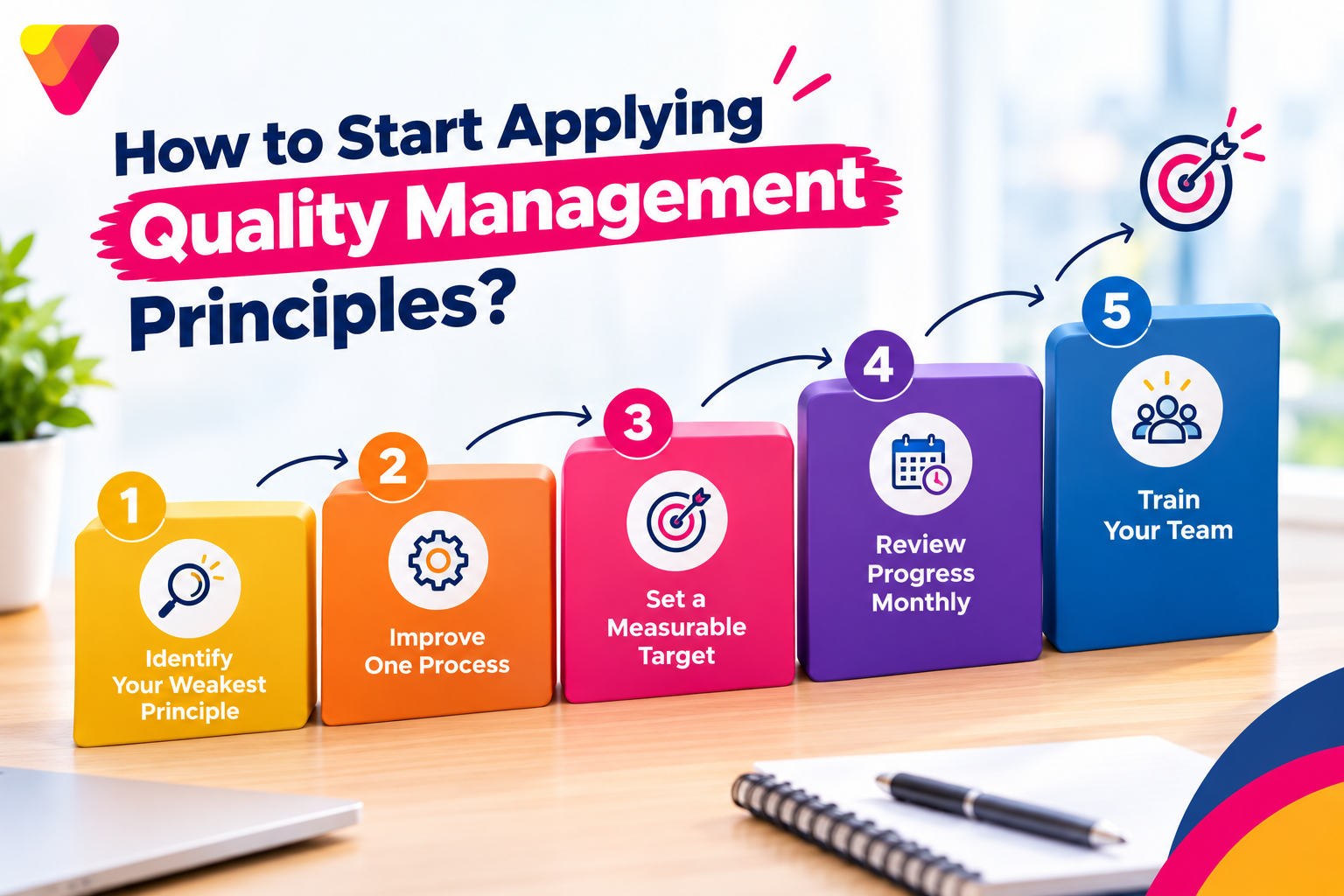
How to Start Applying Quality Management Principles?
- Pick one principle your business is weakest on. A quick team discussion usually reveals it.
- Choose one process to improve. Small and visible wins build support.
- Set one measurable target. For example, reduce late deliveries by 20 percent in a quarter.
- Review progress monthly and adjust.
- Train the people involved. An ISO 9001 internal auditor course helps your team check whether the system works in practice. Not sure which level fits? Read Internal Auditor vs Lead Auditor.
Working in construction? See our practical guide to ISO 9001 for construction companies. To see what auditors usually find in practice, read 10 common ISO 9001 audit findings.
Common Mistakes to Avoid
- Treating principles as theory. If they never change how you work, they are decoration.
- Documenting more than you use. Keep documents that help people control work.
- Leaving quality to one person. A quality manager coordinates, but everyone owns quality.
- Skipping root cause analysis. Fixing symptoms makes problems return.
- Ignoring supplier quality. Incoming problems become your problems.
Frequently Asked Questions
What are the 7 quality management principles?
Customer focus, leadership, engagement of people, process approach, improvement, evidence-based decision making, and relationship management.
Where do the quality management principles come from?
They are defined in ISO 9000:2015 and form the basis of ISO 9001:2015.
How many quality management principles were there before?
Earlier versions of the ISO 9000 family listed eight. The 2015 revision reduced them to seven.
Are quality management principles mandatory?
You cannot be audited against the principles directly. You are audited against ISO 9001 requirements, which are built on them.
Which quality management principle is the most important?
ISO treats them as equally important and connected. Customer focus is often described as the primary aim, with the others supporting it.
Do small businesses need these quality management principles?
Yes. They scale to any size. A small business may apply them with simple tools and less documentation.
Do the principles change with ISO 9001:2026?
Check the latest published standard and our update guide on ISO 9001:2026 for current details.
Conclusion and Next Steps
The seven quality management principles are not abstract theory. They describe what well-run organizations already do: listen to customers, lead from the front, trust and develop people, manage work as connected processes, keep improving, decide with data, and work closely with partners.
If you want to build these skills in your team, explore Verger Academy’s ISO training courses or read more on the benefits of ISO training. To discuss which course suits your team, contact us on WhatsApp.
