
If you’ve started looking into ISO training, you’ve probably run into two course names that sound almost identical: Internal Auditor and Lead Auditor. They’re not interchangeable, and picking the wrong one can cost you time, money, and — if you’re preparing for a certification audit — a failed attempt.
There are usually two kinds of people asking this question. Maybe you’re a quality manager or SME owner who’s been told “someone on the team needs to get certified” before your next ISO audit, and you’re not sure which course actually covers that. Or maybe you’re an individual looking to build a career in auditing or consulting, and you want to know which credential actually opens doors.
Either way, this guide breaks down exactly what each qualification does, who it’s for, and how to decide — without the jargon.
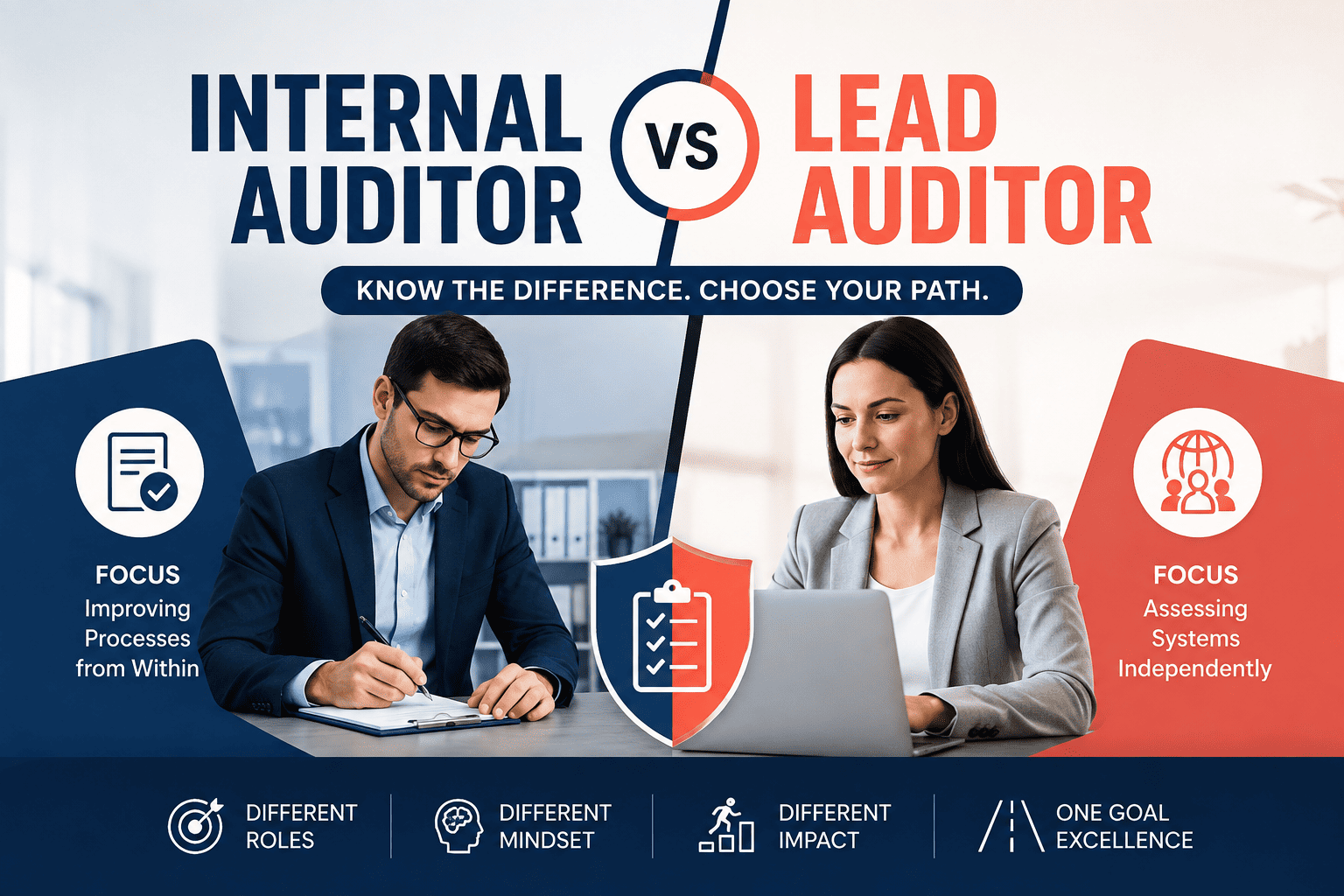
Internal Auditor vs. Lead Auditor comes down to one key distinction: who you’re auditing for.
Internal Auditor training qualifies you to audit your own organization’s management system — checking that your company’s processes conform to a standard like ISO 9001, 45001, or 22000 before an external certification audit. It’s shorter, more affordable, and doesn’t require a formal exam or accreditation to practice.
Lead Auditor training qualifies you to lead audit teams for third-party certification audits — the kind conducted on behalf of a certification body. It’s a longer, exam-based, internationally recognized course (often benchmarked against IRCA-style criteria) and is the credential auditors and consultants build careers on.
So when weighing Internal Auditor vs. Lead Auditor: if you just need to prepare your own company for certification, Internal Auditor is usually enough. If you want to audit other companies, consult, or build a long-term auditing career, you need Lead Auditor.
What Is an ISO Internal Auditor?
An ISO Internal Auditor is trained to assess their own organization’s management system — its Quality Management System (QMS) under ISO 9001, its Occupational Health & Safety system under ISO 45001, or its Food Safety Management System under ISO 22000 — against the requirements of the relevant standard.
In practice, this means checking that documented procedures are actually being followed, that records are in order, and that nonconformities are identified and corrected before an external auditor from a certification body ever walks through the door.
Who typically takes this course:
Quality coordinators and QHSE officers
Operations staff at SMEs who wear multiple hats
Employees nominated to run internal audits ahead of a certification or surveillance audit
Business owners who want hands-on visibility into their own compliance status
Typical format: Most Internal Auditor courses run 1–2 days and combine classroom instruction with practical audit exercises. There’s usually no formal external exam — competency is assessed through participation and a final assessment within the course itself.
What it doesn’t qualify you to do: An Internal Auditor certificate does not authorize you to audit other companies, represent a certification body, or issue ISO certificates. It’s an internal-facing qualification only.
What Is an ISO Lead Auditor?
An ISO Lead Auditor is trained and qualified to plan, lead, and report on audits conducted on behalf of a certification body — the formal, third-party audits that actually result in a company being awarded (or maintaining) ISO certification.
This is a significantly more rigorous course. It covers audit planning, team leadership, evidence-gathering techniques, nonconformity classification, and audit reporting to a standard recognized across the industry — and it ends with a formal, invigilated exam.
Who typically takes this course:
Consultants and freelance auditors
Employees at certification bodies
Quality/HSE managers who want to lead audits, not just support them
Individuals building a long-term career in auditing or ISO consulting
Typical format: Lead Auditor courses typically run 5 days and are exam-based. Passing the exam is what earns you the credential — attendance alone isn’t enough, unlike most Internal Auditor courses.
Career upside: Because Lead Auditor certification is internationally recognized and exam-verified, it’s the credential that opens doors to auditing roles, consulting work, and higher day rates. It’s a bigger investment upfront, but it’s the qualification that has actual market currency outside your own company.
Internal Auditor vs. Lead Auditor: Side-by-Side
| Internal Auditor | Lead Auditor | |
|---|---|---|
| Purpose | Audit your own organization’s management system | Lead third-party/certification body audits |
| Who it’s for | Internal staff, SME teams, quality coordinators | Consultants, auditors, career-focused professionals |
| Typical duration | 1–2 days | 5 days |
| Exam required? | No formal external exam | Yes — formal, invigilated exam |
| Recognized by | Your own organization / internal use | Certification bodies, employers, clients (industry-wide recognition) |
| Typical cost | Lower | Higher |
| Career outcome | Supports internal compliance role | Enables auditing/consulting career path |
Which One Do You Need?
Rather than guessing, match yourself to the scenario that fits:
If you’re an SME preparing for your own certification audit — Internal Auditor is usually all you need. It’s faster, more affordable, and directly addresses the requirement most standards have for periodic internal audits as part of maintaining certification.
If you’re a quality or HSE manager who wants to eventually lead audits or move into consulting — Lead Auditor is the right investment. It’s the credential that’s recognized beyond your own company walls.
If your company needs both — internal audit capability now, and the ability to produce your own lead auditors later — this is common, and it’s why most training providers structure their course catalog as a progression: Awareness → Implementation → Internal Auditor → Lead Auditor. Many organizations start staff on Internal Auditor to build immediate internal capability, then send select employees on to Lead Auditor once there’s a clear business case for it.
Can You Skip Straight to Lead Auditor?
It’s a fair question — if Lead Auditor is the more valuable credential, why not go straight there?
In practice, most training providers recommend completing Internal Auditor training first, even if it’s not always a strict formal prerequisite. Lead Auditor courses move fast and assume you’re already comfortable with basic audit concepts — evidence types, conformance vs. nonconformity, audit trails — so walking in without that foundation makes the 5-day course, and its exam, considerably harder. Starting with Internal Auditor also gives you a lower-cost way to confirm auditing is actually the right path before committing to the bigger investment.
Which Standard Are You Auditing?
The Internal Auditor vs Lead Auditor decision is the same regardless of which management system you’re working with — but the standard itself matters for which course you actually enroll in:
ISO 9001 (Quality Management) — the most common starting point for most businesses
ISO 45001 (Occupational Health & Safety) — essential for construction, industrial, and high-risk work environments
ISO 22000 (Food Safety Management) — required for food production, processing, and hospitality businesses
Each standard has its own Internal Auditor and Lead Auditor tracks, so make sure you’re enrolling in the course that matches the management system your business actually needs certified.
Cost & ROI Considerations
Internal Auditor training is the lower-cost entry point — it’s shorter, requires less time away from work, and gets your team audit-ready quickly. For most SMEs preparing for certification on a budget, it’s the more sensible first step.
Lead Auditor is a bigger investment, both in course fees and the week of time it takes. But it’s an investment that pays back differently — it’s a credential with market value on its own, whether that shows up as consulting income, a stronger CV, or the ability to lead audits for multiple clients rather than just your own company.
If you’re deciding on behalf of a business, the honest framing is: Internal Auditor protects your certification. Lead Auditor builds a career or a service offering.
Frequently Asked Questions
Can an Internal Auditor become a Lead Auditor later?
Yes. It’s a common and recommended progression — many people start with Internal Auditor training to build foundational audit skills, then move on to Lead Auditor once they’re ready for the more advanced, exam-based course.
Do I need a Lead Auditor certificate to get a job in quality management?
Not necessarily. Many quality management roles only require Internal Auditor-level competency, especially at smaller organizations. Lead Auditor becomes more important for roles specifically focused on auditing, consulting, or working with certification bodies.
Is Internal Auditor training enough to pass a certification body’s audit?
Internal Auditor training prepares your team to run internal audits and catch nonconformities before your certification audit — but the certification audit itself is conducted by an external Lead Auditor from an accredited certification body. Internal Auditor training is about readiness, not the certification audit itself.
How long is ISO Lead Auditor training?
Most Lead Auditor courses run 5 days and conclude with a formal exam, compared to the 1–2 days typical of Internal Auditor training.
Ready to Get Certified?
Whether you’re preparing your team for an upcoming audit or building a career in ISO auditing, the right course depends on what you’re trying to achieve.
Ready to audit your own QMS?
Start with our Internal Auditor course →
Building an auditing career?
Explore our Lead Auditor course →
Not sure which standard applies to your business?
Browse our ISO 9001, ISO 45001, and ISO 22000 course pages to find the right fit.

Pingback: 7 Quality Management Principles Explained Simply (2026)