
On September 16, 2026, the International Organization for Standardization (ISO) published the sixth edition of ISO 9001 — the first full revision of the world’s most widely used quality management standard since 2015. This is a genuine milestone: ISO 9001 has been the reference point for quality management systems since 1987, and this revision comes after nearly three years of international development involving experts from dozens of countries.
If your organization holds ISO 9001:2015 certification, is preparing for first-time certification, or manages a quality management system in any capacity, here’s a detailed look at exactly what’s changed, what hasn’t, how the transition works, and what to do next.
At a glance: ISO 9001:2026 replaces ISO 9001:2015 as the current edition. Existing 2015 certificates remain valid — organizations have a three-year transition period, running until approximately September 2029, to move to the new edition. The revision is described by certification bodies as evolutionary rather than revolutionary.
Is ISO 9001:2015 Still Valid?
Yes, and this is worth stating clearly upfront because it’s the single most common point of confusion whenever a standard is revised. Publishing a new edition does not instantly invalidate existing certificates. Organizations currently certified to ISO 9001:2015 keep their certificate and its existing expiration date.
Organizations have a three-year transition period — typically stated as 36 months from the date of publication — to move to ISO 9001:2026, putting the effective deadline at approximately September 2029.
The International Accreditation Forum (IAF) is expected to develop mandatory transition documents that will give certification bodies — and by extension, certified organizations — more specific guidance on exact timelines, audit requirements during the transition, and how existing certificates will be migrated. These documents were still pending as of the standard’s publication, so certification bodies will be issuing more detailed guidance as it becomes available.
Practical takeaway: there’s no need for alarm, but there’s also no advantage to waiting. Certification bodies typically see a crunch of demand as transition deadlines approach, and organizations that start early get more flexibility in audit scheduling.
How We Got Here: The Revision Timeline
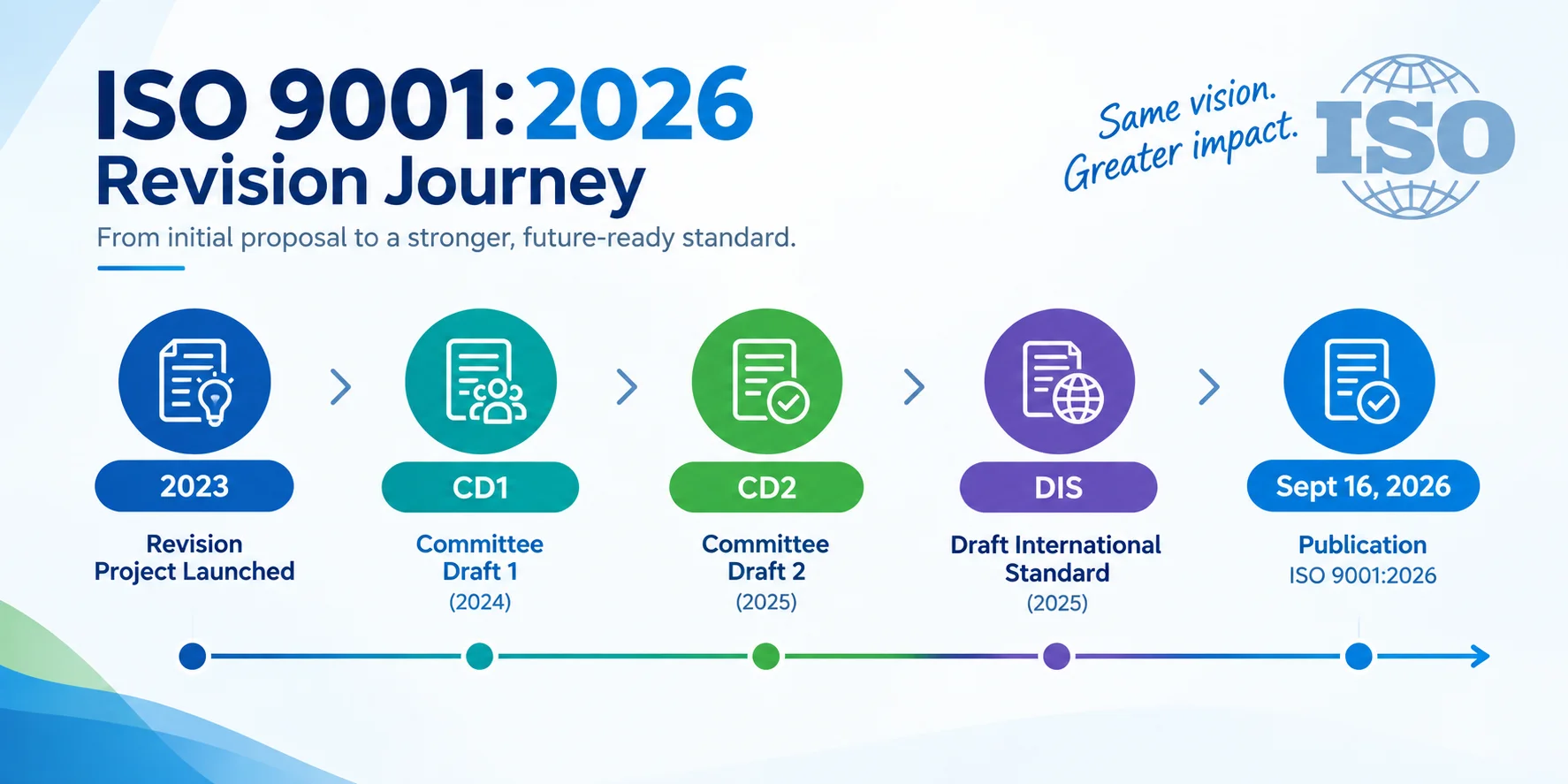
Understanding the process behind this revision helps explain why the changes landed where they did:
Summer 2023 — ISO’s Technical Committee (TC 176, Subcommittee 2) formally decided to revise ISO 9001:2015, after initial consultation on whether an update was needed
January 2024 — The international Working Group began drafting the new version
August 2024 — The first Committee Draft (CD1) was rejected by the ISO Central Secretariat due to structural issues, requiring a second draft
2024 (parallel track) — A climate change amendment was issued to update ISO 9001:2015 directly, while the full revision continued separately
September 2024 — Work began on the Second Committee Draft (CD2)
March 2025 — CD2 closed for comments
August 27, 2025 — The Draft International Standard (DIS) was released to ISO member bodies for formal review and ballot
December 4, 2025 — ISO member countries voted to approve the proposal for the new edition
Early 2026 — The Final Draft International Standard (FDIS) stage was completed
September 16, 2026 — ISO 9001:2026, the sixth edition, was officially published
According to ISO’s own reporting, the revision involved participation from 81 experts representing 46 countries and liaison organizations — reflecting the scale of international collaboration behind a standard used across virtually every sector of the global economy.
What’s Actually Changed: A Detailed Breakdown
Multiple certification bodies — including DNV, SGS, TÜV SÜD, and Intertek — independently describe this revision as evolutionary, not revolutionary. The core architecture of ISO 9001 hasn’t been rebuilt. But within that continuity, several specific, substantive changes stand out.
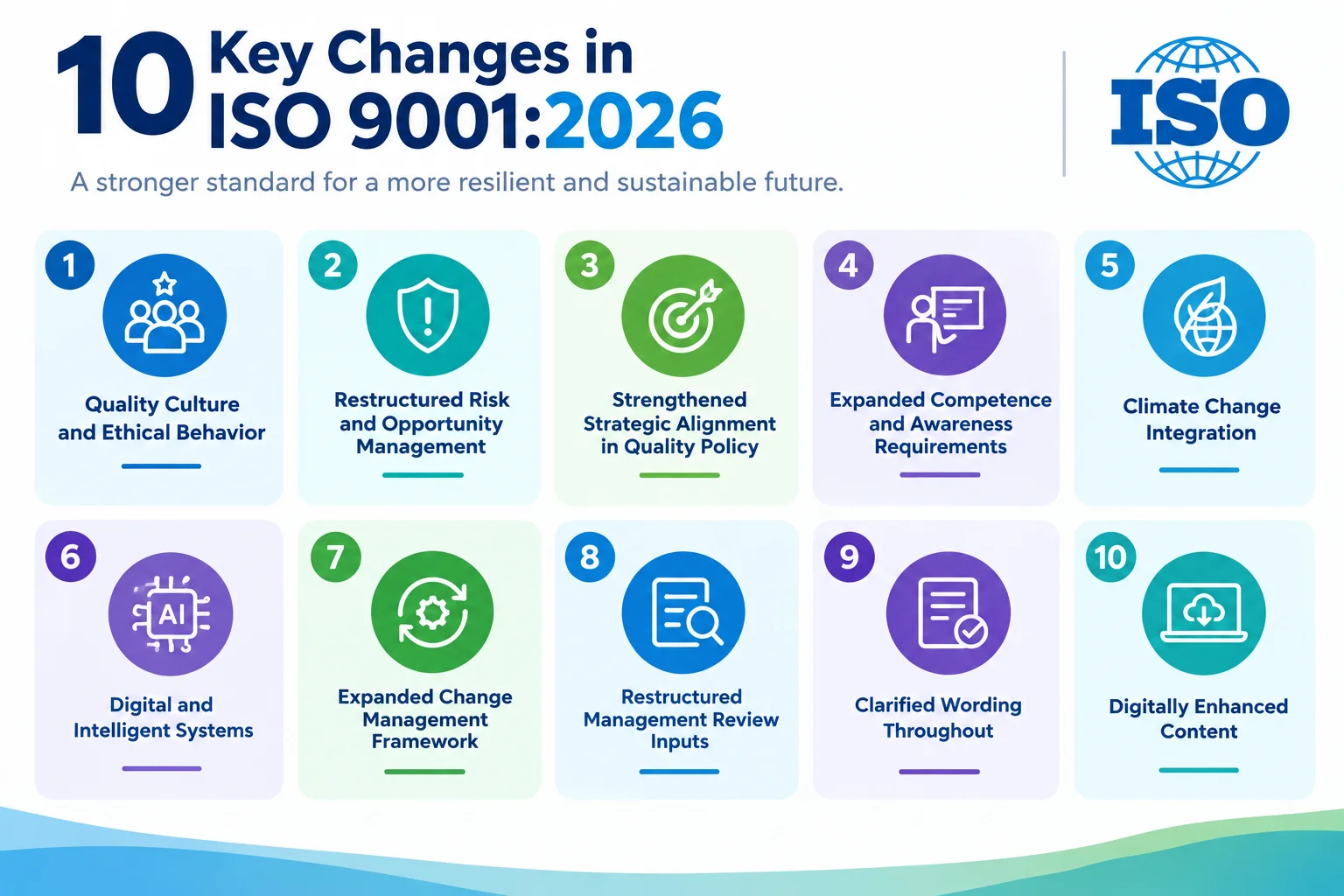
1. Quality Culture and Ethical Behavior (Clause 5.1 — Leadership)
A new entry has been added to the Leadership and Commitment section specifically addressing “promoting quality culture and ethical behaviour.” This includes new guidance on how organizations should demonstrate that this promotion is actually happening — not just documented as a policy statement, but reflected in how leadership actually operates. This is widely flagged as one of the most significant additions in the revision, since it pushes quality management further into cultural and behavioral territory rather than purely procedural compliance.
2. Restructured Risk and Opportunity Management (Clause 6.1)
The clause covering risk and opportunity has been broken down into more detailed sub-sections. Previously handled as a single, relatively broad clause, this restructuring gives organizations clearer, more actionable guidance on how to actually apply risk-based thinking in practice, rather than treating it as a high-level principle referenced once and left unaddressed operationally.
3. Strengthened Strategic Alignment in Quality Policy
The requirements around an organization’s quality policy have been updated to reinforce a stronger connection between the quality policy and the organization’s broader strategic direction — moving the quality policy further away from being a standalone document and closer to a genuine reflection of organizational strategy.
4. Expanded Competence and Awareness Requirements (Clause 7.3)
The clause covering awareness and training has been expanded, with more detailed requirements around ensuring personnel genuinely understand quality objectives and their role in achieving them — not just formal training records, but demonstrated awareness.
5. Climate Change Integration
Climate-related considerations, first introduced as a standalone amendment to ISO 9001:2015 in 2024, are now more fully integrated into the standard itself rather than existing as a bolt-on addition. This reflects a broader pattern across ISO management system standards incorporating climate considerations directly into core requirements.
6. Digital and Intelligent Systems
The revision acknowledges the growing role of artificial intelligence, data analytics, and automation within modern quality management systems — reflecting how many organizations already operate, rather than treating digital tools as external to the standard’s scope.
7. Expanded Change Management Framework
A broader, more structured framework for managing organizational change has been incorporated, giving organizations more explicit guidance on how changes affecting the quality management system should be planned, assessed, and controlled.
8. Restructured Management Review Inputs
The inputs required for management review have been revised to cover the new and restructured elements introduced elsewhere in the standard — meaning management review agendas will need to be updated to reflect quality culture, ethical behavior, and the restructured risk management clauses.
9. Clarified Wording Throughout
Beyond the substantive additions above, a considerable number of requirements have been reworded for clarity across the standard. These aren’t new requirements in most cases, but tighter, less ambiguous language intended to reduce inconsistent interpretation — historically one of the more common sources of friction between organizations and auditors.
10. Digitally Enhanced Content
In a first for ISO, 9001:2026 will be part of ISO’s inaugural offering of digitally enhanced content, available from October 1, 2026. While details of exactly what this format includes are still emerging, it signals a shift toward more interactive or structured digital access to the standard itself, beyond the traditional static PDF/document format.
What Hasn’t Changed?
It’s equally important to be clear about what stayed the same, because it directly shapes how disruptive this transition will actually be:
- The core process approach remains central
- The Plan-Do-Check-Act (PDCA) cycle is retained as the standard’s operating philosophy
- The standard continues to follow the shared Harmonized Structure (the common clause framework
- used across ISO management system standards like ISO 45001 and ISO 22000)
- Risk-based thinking as a foundational principle is retained, just restructured for clearer application
This continuity matters practically: organizations with a mature ISO 9001:2015 system are not starting from zero. Certification bodies are broadly characterizing this transition as significantly less demanding than the shift from the 2008 edition to the 2015 edition, which introduced far larger structural changes (including the current Harmonized Structure itself).
What Organizations Should Do Now?
- Don’t wait for the deadline. A three-year window sounds generous, but certification bodies typically see scheduling bottlenecks as deadlines approach. Starting early preserves flexibility.
- Study the specific clause changes, not just headline summaries — the Leadership (5.1), risk/opportunity (6.1), competence/awareness (7.3), and management review sections are where the most substantive updates concentrate.
- Update internal audit checklists to reflect the new requirements — an internal auditor working from 2015-era checklists will miss exactly the areas the revision targets.
- Train personnel responsible for the QMS, particularly internal auditors and anyone involved in management review, on what’s actually changed.
- Run a formal gap analysis comparing your current quality management system against ISO 9001:2026’s requirements, ideally before your next scheduled surveillance or certification audit.
- Update your quality policy and management review agenda to reflect the strengthened strategic alignment and restructured review inputs.
- Confirm your certification body’s specific transition timeline as IAF’s formal transition documents become available — this will vary somewhat by certification body and region.
Frequently Asked Questions
When was ISO 9001:2026 published?
September 16, 2026.
Do I need to recertify immediately?
No. Existing ISO 9001:2015 certificates remain valid with their existing expiration dates. Organizations have a three-year transition period, running to approximately September 2029.
Is this a major overhaul like the shift to the 2015 edition was?
No. Certification bodies consistently describe this revision as evolutionary — the core process approach, PDCA cycle, and Harmonized Structure are retained. The 2015 revision introduced much larger structural changes by comparison.
What’s the single biggest change to prepare for?
The new emphasis on quality culture and ethical behavior under Leadership (5.1), combined with the restructured risk and opportunity management requirements (6.1), are the two changes most likely to require real, substantive updates to existing documentation and practice.
Do I need to update my internal audit program?
Yes. Internal audit checklists and audit scope should be updated to reflect the new and restructured clauses, particularly around quality culture, ethical behavior, and risk/opportunity management.
Should I still pursue certification against ISO 9001:2015 if I haven’t started yet?
Organizations just beginning the certification process should factor the 2026 edition into their planning and check current timelines directly with their chosen certification body, since new certifications may increasingly be issued against the 2026 edition going forward rather than the outgoing 2015 edition.
What does “digitally enhanced content” mean for ISO 9001:2026?
ISO 9001:2026 is part of ISO’s first offering of digitally enhanced content, available from October 1, 2026 — a new, more interactive format for accessing the standard, though full details of this format are still emerging.
Final Thoughts
ISO 9001:2026 is not a reason to panic, but it is a reason to start paying attention now, while the three-year transition window still gives organizations genuine breathing room. The changes are real and substantive — particularly the shift toward quality culture, ethical governance, and more actionable risk management — even if the overall architecture of the standard remains recognizable to anyone already familiar with the 2015 edition.
Organizations that treat this as a genuine opportunity to strengthen their quality management system, rather than a compliance checkbox to update at the last minute, will get considerably more value out of the transition than those who wait.
