
A construction project rarely goes exactly as planned.
There are drawings to manage, materials to approve, suppliers to coordinate, subcontractors to supervise, inspections to complete, and clients who expect the work to meet agreed requirements. When these activities are not properly controlled, even a small mistake can lead to rework, delays, additional costs, or a dissatisfied client.
This is where ISO 9001 for Construction Industry can make a practical difference.
For a construction company, ISO 9001 is not just about having procedures or preparing for a certification audit. It is about having a clear way of managing quality throughout a project — from the initial requirements and procurement stage to construction, inspection, handover, and improvement.
Why Quality Management Matters in Construction?
Quality problems can be expensive in construction.
Research published in the Journal of Construction Engineering and Management found that direct rework costs in construction projects could reach around 5% of total construction costs. The study examined 359 projects from the Construction Industry Institute database.
A more recent 2026 study reported by the American Society of Civil Engineers found average field rework costs of 0.38% of contract value before project completion. When post-completion corrections were also included, the figure increased to 0.76%.
The numbers vary from project to project, but the message is simple: poor quality can cost money.
Rework is also rarely caused by one person or one mistake. It can start with an unclear requirement, an outdated drawing, an unsuitable supplier, incorrect material, inadequate training, poor communication, or a problem that was not identified during inspection.
A good quality management system helps a company look at these processes before they become bigger problems.
How ISO 9001 Fits into Construction?
ISO 9001 for Construction Industry can be applied to almost every stage of a construction project.
Think of a typical project.
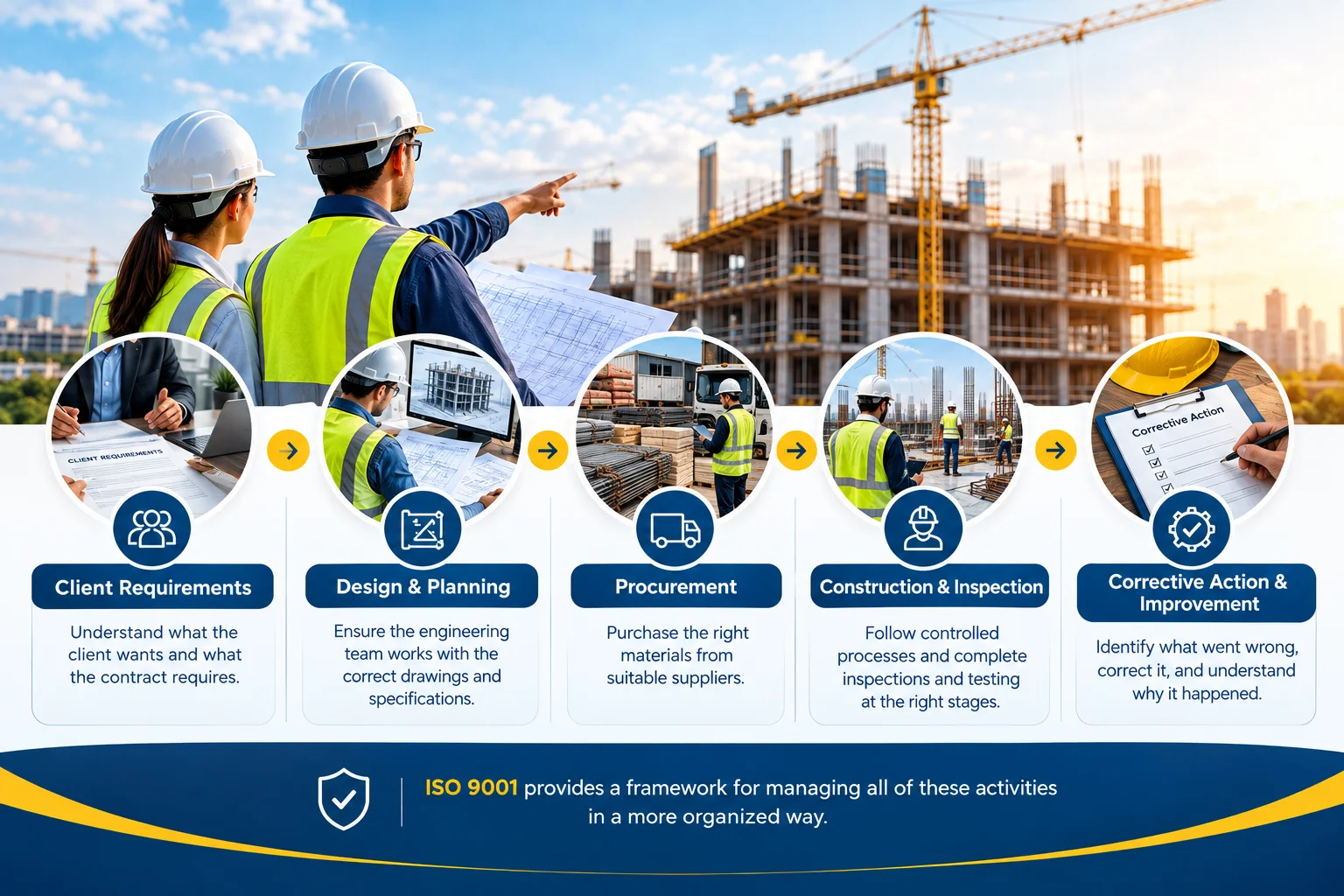
Before work starts, the company needs to understand what the client wants and what the contract requires. The engineering team needs to work with the correct drawings and specifications. Procurement needs to purchase the right materials from suitable suppliers. Site teams need to follow controlled processes. Inspections and testing need to be completed at the right stages.
If something goes wrong, the company needs to identify it, correct it, and understand why it happened.
ISO 9001 provides a framework for managing all of these activities in a more organized way.
Where ISO 9001 Can Be Used in a Construction Company?
The standard does not have to sit separately from normal construction operations. It can be built into the way the company already works.
Project Planning
Quality starts before workers arrive on site.
During project planning, the company can identify client requirements, applicable regulations, project risks, resources, responsibilities, inspection requirements, and quality objectives.
This gives the project team a clearer understanding of what needs to be achieved and how quality will be monitored.
Design and Drawing Control
Construction teams often work with large numbers of drawings, specifications, revisions, and technical documents.
Using an outdated drawing can create a serious problem.
A controlled process helps ensure that the people doing the work have access to the correct and approved information. Changes can also be reviewed and communicated to the relevant people.
Procurement
Buying the cheapest material is not necessarily the best option if it does not meet the project requirements.
A quality management system can help construction companies define purchasing requirements, evaluate suppliers, check incoming materials, and maintain appropriate records.
For example, before a material is accepted for use, the company may need to check its specification, certificates, test reports, quantity, condition, or other project requirements.
Subcontractor Management
Subcontractors can have a major influence on the quality of a project.
A construction company may have excellent internal procedures, but if an important subcontracted activity is poorly controlled, the final result can still be affected.
ISO 9001 encourages organizations to establish suitable controls for externally provided processes, products, and services.
This can include evaluating subcontractors before appointment and monitoring their performance during the project.
Site Work
Once construction begins, quality becomes part of everyday work.
Workers and supervisors need to know what is expected, what specifications apply, what inspections are required, and what should happen if the work does not meet requirements.
The goal is to identify problems as early as possible rather than discovering them when the project is almost complete.
The Role of Inspection and Testing
Inspection is an important part of construction quality, but it should not be the only quality activity.
Imagine a wall has been constructed incorrectly and the problem is discovered only after the work is complete. The company now has to spend additional time and money removing and rebuilding it.
A better approach is to have appropriate inspection points during the work.
Construction companies may use tools such as Inspection and Test Plans (ITPs), inspection checklists, material inspection records, test reports, and approval records to provide evidence that requirements have been checked.
The exact inspection requirements depend on the type of project and contractual requirements.
What Happens When Something Goes Wrong?
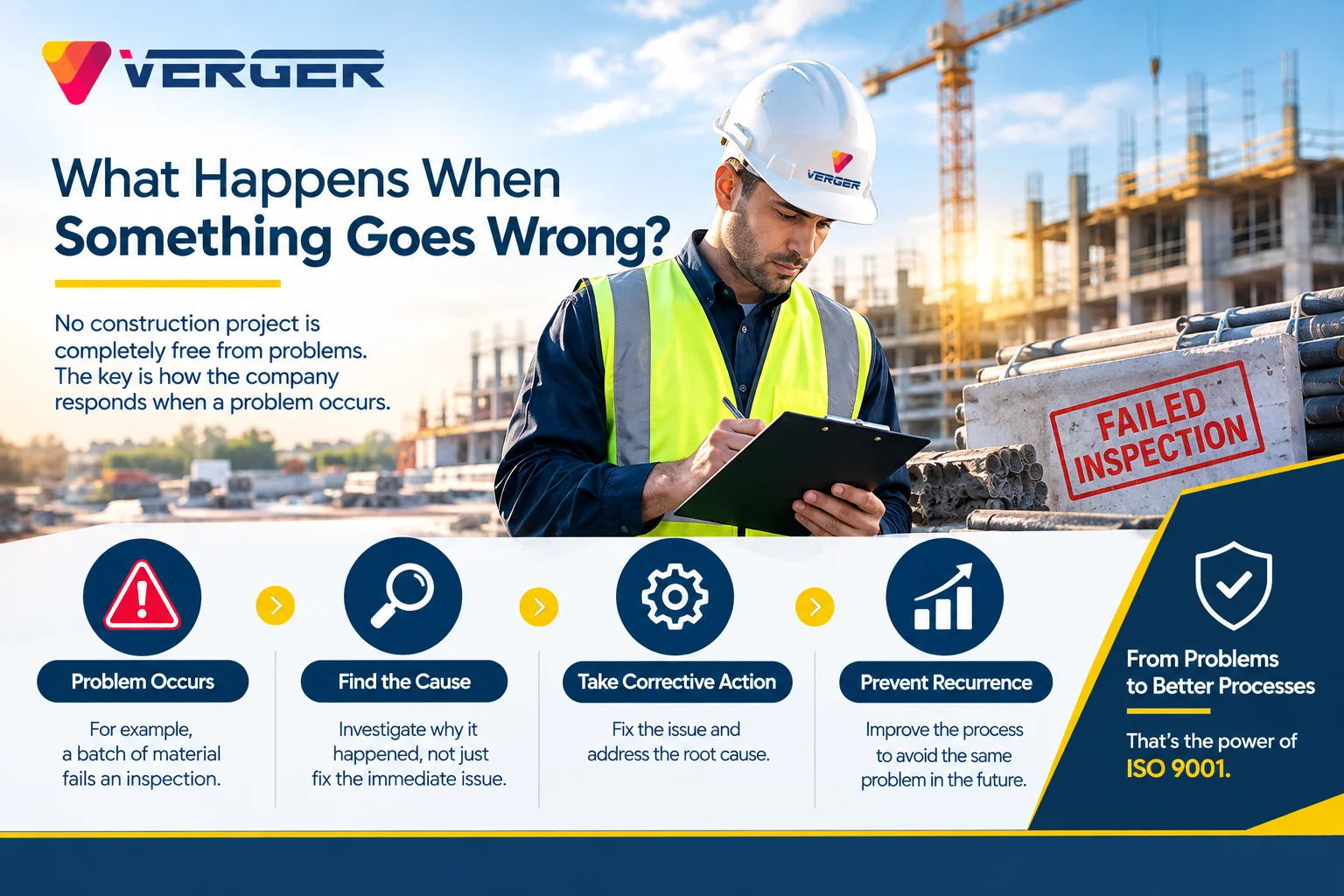
No construction project is completely free from problems.
The important question is how the company responds when a problem occurs.
Suppose a batch of material fails an inspection. Simply replacing the material solves the immediate problem, but the company may also want to understand why the incorrect material was purchased in the first place.
Was the purchase specification unclear?
Was the supplier not properly evaluated?
Was the wrong item ordered?
Was the material checked when it arrived?
This is where corrective action becomes useful.
Instead of repeatedly fixing the same type of problem, the organization can investigate its cause and improve the process.
Benefits of ISO 9001 for Construction Companies
The benefits of ISO 9001 for Construction Industry are easier to understand when they are connected to everyday construction problems.
1. Less Rework
When requirements, processes, inspections, and responsibilities are clearly defined, problems can be identified earlier.
Reducing rework can save labour, materials, equipment time, and project resources.
2. Better Control of Suppliers
A construction company can establish a consistent method for selecting and monitoring suppliers.
Instead of finding out that a supplier is unreliable after a problem occurs, supplier performance can be reviewed throughout the relationship.
3. Better Control of Subcontractors
The same principle applies to subcontractors.
Clear requirements, defined responsibilities, monitoring, and performance evaluation can help the main contractor maintain better control over outsourced activities.
4. Fewer Documentation Problems
Construction projects generate a huge amount of information.
Drawings, inspection records, material certificates, test results, approvals, reports, and revisions all need to be managed.
A controlled system makes it easier to know which information is current and where important records can be found.
5. More Consistent Work
Different teams may otherwise follow different methods for completing similar activities.
A QMS helps establish a consistent approach while still allowing procedures to be adapted to the actual project.
6. Better Handling of Client Complaints
Client complaints can provide useful information about where a process needs improvement.
Instead of simply responding to each complaint individually, the company can look for recurring causes and take action to prevent similar issues.
7. Clearer Responsibilities
Quality should not be the responsibility of one quality manager.
Project managers, engineers, procurement teams, supervisors, workers, and subcontractors all influence project quality.
A well-implemented QMS helps clarify who is responsible for different activities and decisions.
8. Continual Improvement
A construction company can use audit findings, inspection results, complaints, nonconformities, supplier performance, and project data to identify areas that can be improved.
This helps the QMS develop along with the organization.
ISO 9001 and Construction Project Performance
There is also research showing a relationship between structured quality management and construction performance.
A study of 86 construction organizations in Jordan found that ISO 9001-certified organizations reported stronger performance in areas such as project-management leadership, policies, project lifecycle management, and performance indicators. The researchers also reported higher project success among the certified organizations studied.
Another study of construction companies in Pakistan reported benefits associated with ISO 9001 implementation, including reduced material waste, improved employee satisfaction, improved ability to attract new projects, and stronger relationships in international markets.
These studies do not mean that certification automatically makes every construction project successful. The result depends heavily on how the system is implemented and whether employees actually use it.
That distinction is important.
A certificate alone does not improve construction quality. A working quality management system can.
What Documents Are Commonly Used?
One concern construction companies sometimes have is the amount of paperwork involved.
ISO 9001 does require organizations to maintain appropriate documented information, but that does not mean every activity needs a complicated procedure.
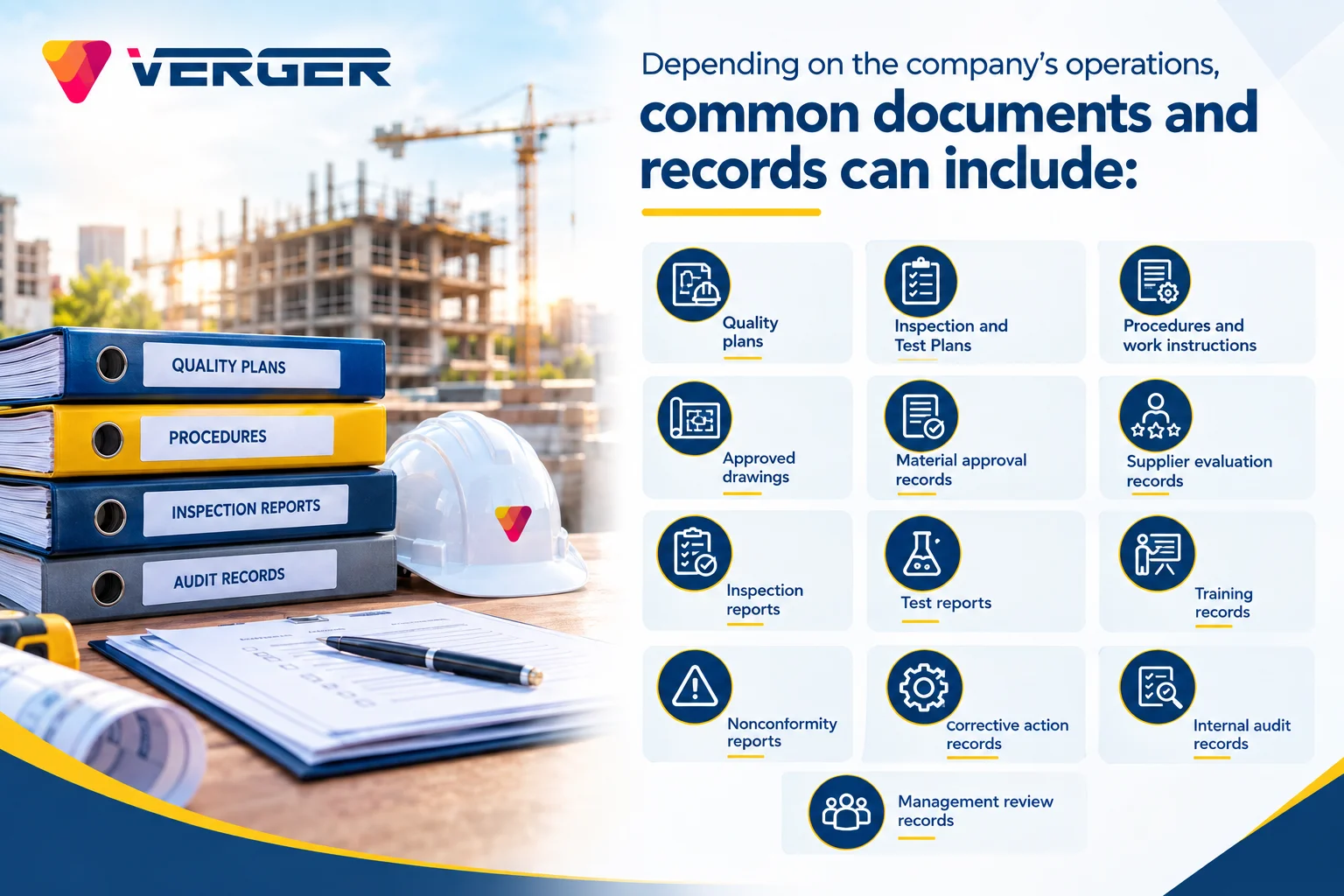
The important point is that documentation should **help people control their work**, not simply create paperwork for the sake of an audit.
Training Employees for ISO 9001
Having a QMS is one thing. Getting employees to understand and use it is another.
A project engineer may need to understand document control and project requirements. A procurement employee may need to understand supplier evaluation. A quality inspector needs to know how to conduct inspections and record evidence. Managers need to understand quality objectives, risks, and improvement.
This is why employee training is an important part of implementation.
Research on construction companies has also highlighted the importance of employee education and training in quality-management practices. One study examining construction companies in Turkey found that quality-awareness education and training in quality-management methods were among the areas associated with more advanced quality-management practices.
How to Implement ISO 9001 in a Construction Company?
The implementation process does not have to begin with writing a large quality manual.
A more practical approach is to first understand how the company currently works.
Start With Existing Processes
Look at what happens from the moment a project is received until it is handed over.
Where are client requirements reviewed?
How are suppliers selected?
Who approves materials?
How are drawings controlled?
How are inspections planned?
What happens when work does not meet requirements?
These questions help identify how the existing business operates.
Identify the Gaps
Once the current processes are understood, the organization can compare them with ISO 9001 requirements.
This can reveal areas where processes need to be introduced, improved, or better documented.
Train the People Involved
Employees should understand the parts of ISO 9001 that relate to their work.
Training does not have to be purely theoretical. Construction employees can learn through examples based on procurement, site activities, inspections, nonconformities, subcontractors, and project documentation.
Put the System Into Practice
The QMS should then be used in actual projects.
Employees should follow the processes, maintain appropriate records, identify problems, and provide feedback when something does not work well.
Audit and Improve
Internal audits can help the organization check whether its processes are being followed and whether they are effective.
Management can then review the results and decide where improvements are needed.
ISO 9001 Certification for Construction Companies
Once the QMS has been implemented and is operating effectively, a construction company can pursue ISO 9001 certification through an independent certification body.
The certification audit looks at whether the organization’s management system meets the applicable requirements of ISO 9001.
The organization may need to demonstrate evidence of how it manages areas such as project requirements, processes, suppliers, competence, inspections, nonconformities, internal audits, and improvement.
Certification should therefore be seen as the outcome of a functioning management system — not the starting point.
Is ISO 9001 Only for Large Construction Companies?
No.
The approach can be applied to organizations of different sizes.
A large construction contractor may have several departments, project locations, and hundreds of employees. A smaller contractor may have a much simpler structure.
The QMS should reflect the organization’s size, activities, risks, and complexity.
The objective is not to create a system that looks impressive on paper. It is to create a system that people can actually use.

Frequently Asked Questions About ISO Standards in Construction
What are the 6 ISO construction types?
There are no six official “ISO construction types.” However, several ISO standards are commonly used by construction companies because they address different areas of business and project management.
Six standards that construction organizations may commonly come across are:
1. ISO 9001 – Quality Management Systems
2. ISO 14001 – Environmental Management Systems
3. ISO 45001 – Occupational Health and Safety Management Systems
4. ISO 50001 – Energy Management Systems
5. ISO 37001 – Anti-Bribery Management Systems
6. ISO 27001 – Information Security Management Systems
The most relevant standard depends on what the construction company is trying to manage. For example, ISO 9001 focuses on quality, ISO 14001 on environmental management, and ISO 45001 on occupational health and safety.
What are ISO standards in construction?
ISO standards in construction are internationally recognized guidelines that help companies manage quality, safety, environmental performance, and other key processes. ISO 9001 for construction industry focuses on quality management, while ISO 45001 covers occupational health and safety and ISO 14001 addresses environmental management.
Which ISO standard is commonly used for construction quality management?
ISO 9001 is the main ISO standard used for Quality Management Systems. Construction companies can use it to establish processes for managing customer requirements, suppliers, subcontractors, inspections, nonconformities, documentation, and continual improvement.
Is ISO 9001 mandatory for construction companies?
ISO 9001 certification is not automatically mandatory for every construction company. However, particular clients, contracts, tenders, regulators, or supply-chain requirements may require a company to demonstrate compliance with specific standards.
Construction companies should therefore check the requirements applicable to their projects, contracts, and markets.
What is the difference between ISO 9001 and ISO 45001 in construction?
ISO 9001 focuses on quality management, while ISO 45001 focuses on occupational health and safety management. In the ISO 9001 for construction industry, the standard helps organizations control processes, improve quality, and meet customer requirements.
A construction company may implement both because ISO 9001 for construction industry addresses quality management, while ISO 45001 addresses worker health and safety.
Can a small construction company implement ISO 9001?
Yes. ISO 9001 can be implemented by organizations of different sizes.
The QMS should be appropriate to the company’s size, activities, risks, resources, and operational complexity. A smaller contractor does not necessarily need the same level of documentation or organizational structure as a large construction group.
Final Thoughts
ISO 9001 for Construction Industry is ultimately about bringing more control and consistency to the way construction work is planned, performed, checked, and improved.
It can help companies address everyday challenges such as supplier problems, subcontractor performance, document control, material quality, inspection, rework, and customer complaints.
The real value comes when ISO 9001 becomes part of the way people work — from the project manager reviewing requirements to the site team checking work and the management team reviewing performance.
For construction companies considering certification, the best starting point is to understand the processes already in place, identify where quality problems occur, and then build a QMS around the organization’s actual work.
Train Your Construction Team with VERGER Academy
Verger Academy provides practical ISO 9001 training for construction company employees, covering quality management, implementation, internal auditing, risk-based thinking, and process control.
Training can be tailored to help employees understand how ISO 9001 requirements apply to their actual construction projects and day-to-day responsibilities.
