
A corrective action is not successful simply because it has been completed. The real test is whether it has addressed the cause of a nonconformity and achieved the intended result.
Consider a manufacturing company that repeatedly receives complaints about defective products. The company investigates the issue, updates its production procedure, and trains employees. The corrective action is marked as complete.
But what happens if defective products continue to reach customers?
This situation highlights an important distinction in quality management: implementing a corrective action and verifying its effectiveness are two different activities.
Under ISO 9001:2026, Clause 10.2 addresses nonconformity and corrective action, including the need to review the effectiveness of corrective action taken. Organizations need appropriate evidence to determine whether their actions have worked rather than relying solely on completed records or management assurances.
For quality managers, QMS professionals, and internal auditors, understanding how to verify corrective action effectiveness is essential to maintaining an effective Quality Management System (QMS).
This article explains how to assess corrective action effectiveness, establish meaningful verification criteria, examine objective evidence, and determine what to do when an action fails to deliver the expected results.
What Is Corrective Action Effectiveness in ISO 9001?
Corrective action effectiveness refers to whether an action has successfully addressed the cause of a nonconformity and achieved the intended outcome.
In practical terms, an action should not be considered effective merely because a procedure was revised, an employee attended training, or a new control was introduced. There must be evidence that the action has worked under relevant operating conditions.
For example, suppose a company repeatedly identifies incorrect product labels during final inspection.
The company corrects the affected products by replacing the labels. However, this only addresses the immediate problem.
An investigation reveals that the production process does not include an effective check of label versions before printing. The company introduces a controlled label approval process and updates the production instructions.
To verify effectiveness, the company subsequently examines production records, checks whether the new approval process is followed, and reviews whether incorrect labels continue to occur.
If the evidence demonstrates that the action has addressed the identified cause and achieved its intended outcome, the organization has a basis for concluding that the action was effective.
The key question is: Does the available evidence demonstrate that the corrective action worked?
What Does ISO 9001:2026 Require for Corrective Action Effectiveness?
ISO 9001:2026 Clause 10.2, Nonconformity and corrective action, addresses how an organization responds to nonconformities and evaluates the actions taken.
In the context of corrective action effectiveness, organizations need to consider whether they have:
- Responded to the nonconformity and controlled or corrected it, as appropriate.
- Investigated the cause of the nonconformity.
- Considered whether similar nonconformities exist or could occur elsewhere.
- Implemented the corrective action needed.
- Reviewed the effectiveness of the corrective action.
- Retained documented information showing the nonconformity, subsequent actions, and results of corrective action.
The response should be appropriate to the effects of the nonconformity. The depth of investigation and verification should therefore reflect the circumstances and significance of the issue.
ISO 9001 does not prescribe one universal monitoring period, sample size, or verification method for every corrective action. Organizations need to determine an appropriate approach based on the nature of the problem, the action taken, and the evidence required to establish whether the action has worked.
For conformity assessments, consult the official published edition of ISO 9001 and the organization’s applicable requirements.
How to Verify Corrective Action Effectiveness?
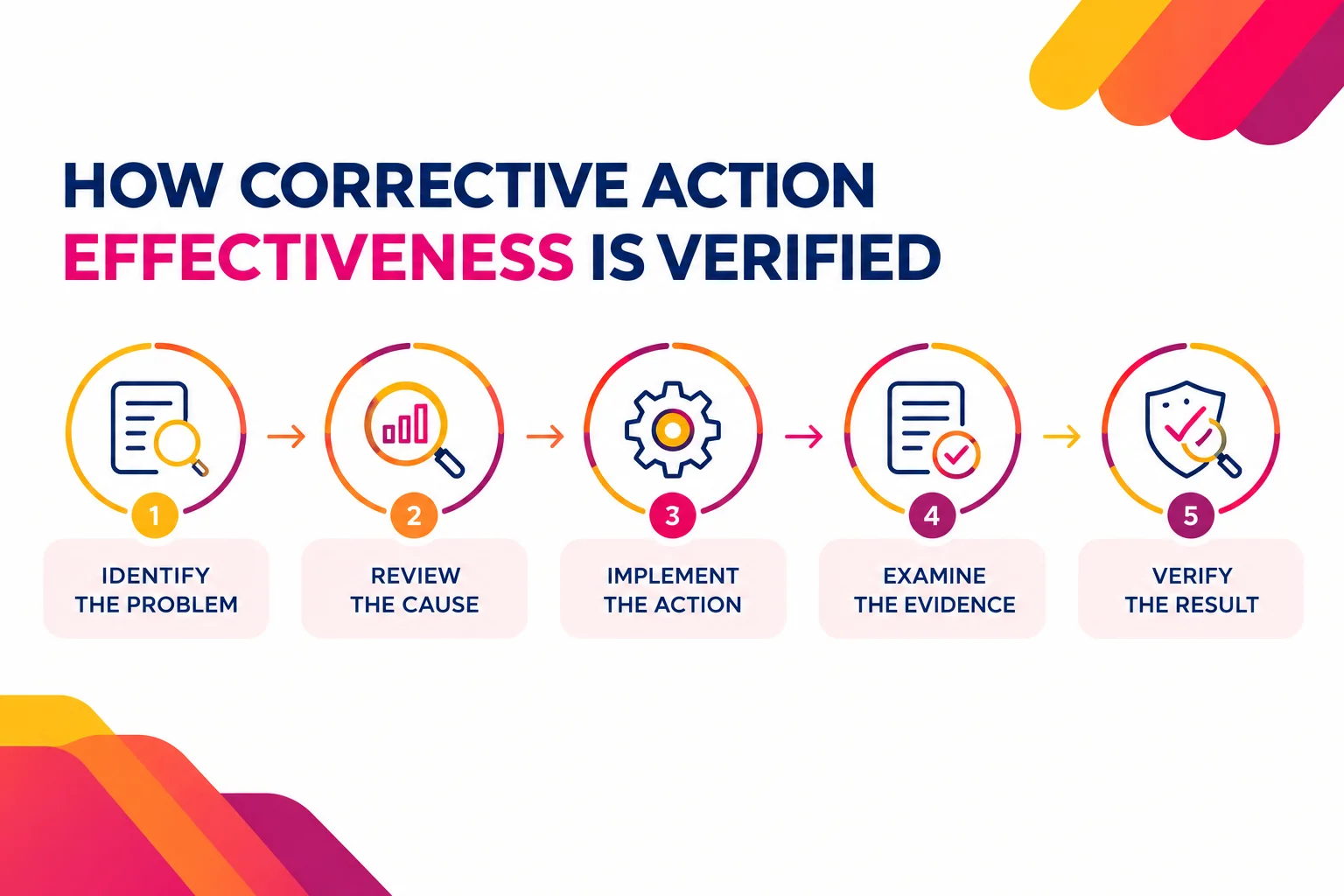
A reliable verification process examines the original problem, the cause identified, the action implemented, and the results obtained.
1. Understand the Original Nonconformity
Before evaluating the corrective action, establish exactly what went wrong.
Review the original audit finding, customer complaint, inspection result, process record, or other evidence that identified the nonconformity.
Determine:
- What requirement was not met?
- Which product, process, or service was affected?
- What evidence demonstrated the problem?
- How frequently did it occur?
- What were its consequences?
- Could the problem affect other products, processes, or locations?
A clear understanding of the original issue provides a reference point against which effectiveness can be assessed.
For example, the statement “inspection errors occurred” does not explain the nature or extent of the problem.
A more useful description would identify the inspection requirement that was missed, the affected production batches, and the records demonstrating the failure.
Without this information, it becomes difficult to determine whether the corrective action has achieved the intended result.
2. Evaluate Whether the Action Addresses the Cause
The effectiveness of a corrective action depends partly on whether it addresses the cause identified during the investigation.
Suppose an organization discovers that measuring instruments are being used after their calibration due dates.
The initial response is to remove the affected instruments from use and arrange calibration. However, the investigation finds that the calibration tracking process relies on manual reminders and has no clear escalation procedure.
If the organization only calibrates the overdue instruments, the immediate issue may be resolved while the underlying weakness remains.
A corrective action that improves calibration tracking, assigns responsibility for monitoring due dates, and introduces appropriate escalation controls may better address the identified cause.
The organization must then determine whether those controls work in practice.
A useful verification question is: How does the action address the cause identified in the investigation?
If the relationship between the cause and the action is unclear, further evaluation may be necessary before effectiveness can be established.
3. Confirm That the Corrective Action Was Implemented
An action cannot be evaluated properly if there is no evidence that it was implemented as intended.
Review relevant records and, where appropriate, observe the process in operation.
Evidence may include revised procedures, updated production instructions, equipment changes, system records, training records, or observations of employees performing the revised process.
For example, an organization may approve a new inspection procedure but fail to communicate it to the employees responsible for carrying out the inspection.
The revised document exists, but the intended process change may not have been implemented consistently.
Verification should therefore distinguish between documented approval and actual implementation.
However, implementation alone does not establish effectiveness. It only confirms that the planned action has been put into practice.
4. Establish Clear Effectiveness Criteria
Before evaluating the results, determine what would demonstrate that the corrective action has worked.
The criteria should relate directly to the original nonconformity and the intended outcome.
Depending on the issue, suitable criteria may include:
- No recurrence of the identified defect during a defined period of normal production.
- A measurable reduction in product rejection rates.
- Consistent completion of required inspections.
- No overdue calibration items within the defined scope.
- Reduced customer complaints associated with the original issue.
- Consistent application of a revised process.
- Evidence that a newly introduced control prevents the identified failure.
Where possible, use measurable criteria rather than general statements such as “the process has improved.”
For example, an organization addressing missed inspections could define a criterion requiring all mandatory inspections to be completed correctly across an appropriate sample of production batches.
The sample and monitoring period should be suitable for the process. A small sample may provide insufficient evidence for a high-risk or infrequent problem.
Clear criteria make the final effectiveness decision more objective and easier to justify.
5. Determine When Verification Should Take Place
Timing matters because a corrective action may appear successful immediately after implementation but fail during normal operations.
The appropriate verification period depends on how frequently the process operates, how the problem occurs, and how long it takes for meaningful evidence to become available.
For example, an updated document-control process may be assessed by examining records generated after implementation. A new calibration tracking system may need to be evaluated across relevant due-date cycles. A corrective action addressing recurring manufacturing defects may require evidence from several production runs.
Waiting longer does not automatically make verification more reliable. The objective is to collect sufficient relevant evidence to support a reasonable conclusion.
If the process has not operated enough times to demonstrate the intended result, the organization may need to record that effectiveness has not yet been verified and arrange follow-up.
6. Examine Objective Evidence
The verification decision should be based on evidence relevant to the original nonconformity and the corrective action taken.
Depending on the situation, evidence may include:
- Inspection and test results.
- Production or service records.
- Customer complaint data.
- Process performance measurements.
- Equipment maintenance or calibration records.
- Observations of revised working practices.
- Interviews with employees performing the process.
- Records demonstrating that new controls are operating as intended.
For example, if an organization introduces a new inspection control, reviewing the revised procedure alone will not establish that the control is effective.
The verifier may also need to examine completed inspection records and observe whether employees apply the control correctly.
Using more than one source of evidence can strengthen the conclusion where appropriate.
Evidence should be relevant, reliable, and proportionate to the significance of the nonconformity. The objective is not to collect as many records as possible, but to determine whether the available information demonstrates the intended result.
7. Check Whether the Problem Has Recurred
One of the clearest indicators of an ineffective corrective action is the recurrence of the same nonconformity.
However, the absence of a repeat finding does not automatically prove that an action was effective. There may have been too few opportunities for the problem to occur, or the monitoring period may have been insufficient.
The verifier should consider the results alongside the nature of the process and the evidence collected.
It is also important to consider whether the same cause could affect other products, departments, sites, or processes.
For example, if a manufacturing defect resulted from an unclear work instruction, similar instructions used on another production line may need to be reviewed.
The extent of this review should be appropriate to the potential impact and the findings of the original investigation.
8. Make and Document the Effectiveness Decision
After reviewing the implementation and results, determine whether the evidence supports the conclusion that the corrective action has worked.
A practical classification could use the following outcomes:
Effective: The evidence demonstrates that the action addressed the identified cause and achieved the intended result.
Ineffective: The problem has recurred, the cause remains, or the action has not achieved its intended result.
Not yet verified: The action has been implemented, but sufficient evidence is not yet available to determine its effectiveness.
These are practical status descriptions rather than prescribed ISO categories. Organizations may use their own documented process.
The decision should explain what was examined, what the evidence showed, and why it supports the conclusion.
For example, recording “action effective” provides little information by itself. A stronger record identifies the production batches reviewed, the inspection results obtained, and how those results demonstrate that the revised control is operating as intended.
Where effectiveness has not been established, the organization should arrange appropriate follow-up rather than treating implementation as proof of success.
Practical Example: Verifying Corrective Action for Repeated Product Defects
Consider a manufacturer that repeatedly discovers products with incorrect dimensions during final inspection.
The problem: Several production batches fail to meet the specified dimensional requirements.
The immediate correction: The company segregates the affected products, assesses their status, and takes appropriate action to prevent nonconforming products from being released.
The investigation: The company determines that the measurement method used during production does not consistently identify dimensional deviations early enough.
The corrective action: The company improves the measurement process, updates the relevant work instructions, and ensures that employees understand how and when measurements must be performed.
The verification plan: The quality team defines suitable criteria based on the original problem. It reviews inspection records from subsequent production runs, observes the revised measurement process, and checks whether the new control is being applied consistently.
The results: The team finds that the measurement process is being followed and the sampled production runs meet the relevant dimensional requirements. The evidence supports the conclusion that the action has been effective for the scope and period examined.
If the same defect continues to appear, the organization should reassess whether the identified cause was correct, whether the action was implemented properly, or whether additional contributing factors remain.
This example illustrates an important principle: effectiveness must be demonstrated by results, not assumed from the action taken.

Common Mistakes When Verifying Corrective Action Effectiveness
Closing the action as soon as it is implemented
Updating a procedure, delivering training, or replacing equipment may complete an assigned task without proving that the problem has been resolved.
Better approach: Evaluate the results after implementation using evidence related to the original issue.
Accepting an unsupported root cause
A statement such as “human error” may describe how a problem occurred without adequately explaining why the process allowed it to happen.
Better approach: Check whether the investigation is supported by evidence and whether the corrective action addresses the identified cause.
Using vague effectiveness criteria
Statements such as “quality improved” or “employees are aware” do not clearly demonstrate success.
Better approach: Define relevant criteria that can be evaluated through records, observations, measurements, or other suitable evidence.
Verifying too early
A process may appear effective immediately after a change but fail when normal operating conditions resume.
Better approach: Allow enough time and process activity to collect meaningful evidence.
Relying on the absence of complaints
A lack of complaints may not demonstrate effectiveness if the organization has had limited customer activity or insufficient time to detect recurrence.
Better approach: Consider other relevant evidence, such as inspection results and process performance data.
Ignoring the possibility of similar problems elsewhere
A corrective action may resolve a local issue while the same cause remains in another relevant process.
Better approach: Consider the wider implications identified during the investigation and extend the verification where justified.
What If Corrective Action Effectiveness Cannot Be Demonstrated?
If the evidence does not establish that a corrective action has worked, the organization should determine the appropriate next steps.
First, review whether the action was implemented as planned. If implementation was incomplete, address that issue.
Next, reassess the original investigation. The identified cause may have been incomplete, based on an incorrect assumption, or affected by additional contributing factors.
The organization should then determine whether the corrective action needs to be revised or strengthened. It may also need to consider whether similar weaknesses exist elsewhere.
Finally, establish suitable criteria for further verification and collect evidence to evaluate the revised action.
The response should be proportionate to the significance of the problem and consistent with the organization’s corrective action process.
An ineffective corrective action is an opportunity to improve the problem-solving process. Repeating the same action without understanding why it failed is unlikely to produce a reliable outcome.
Frequently Asked Questions
How do you verify corrective action effectiveness in ISO 9001?
Review the original nonconformity, assess whether the action addresses the identified cause, confirm implementation, define suitable effectiveness criteria, and examine objective evidence. The final decision should be supported by the results obtained.
Which ISO 9001 clause covers corrective action effectiveness?
ISO 9001:2026 Clause 10.2, Nonconformity and corrective action, includes the review of corrective action effectiveness. Consult the official published standard when assessing conformity.
What evidence demonstrates corrective action effectiveness?
Depending on the issue, evidence may include inspection results, process performance data, complaint records, observations, interviews, equipment records, or evidence that revised controls are operating as intended.
How long should corrective action effectiveness be monitored?
There is no single monitoring period suitable for every corrective action. The period should reflect the nature of the nonconformity, the frequency of the process, the potential consequences, and the time needed to collect meaningful evidence.
Can a corrective action be considered effective immediately after implementation?
Implementation and effectiveness are different. An action may be implemented successfully, but its effectiveness may remain unverified until sufficient evidence demonstrates the intended result.
Who should verify corrective action effectiveness?
The organization should assign a competent person who can evaluate the evidence objectively. Depending on the circumstances and the organization’s procedures, the verifier may be someone other than the person responsible for implementing the action.
Explore More on ISO 9001
ISO 9001 Internal Audit Checklist
ISO 45001 Safety Audit Checklist
ISO 9001 in Manufacturing Industry
Conclusion
Verifying corrective action effectiveness is an essential part of maintaining an effective Quality Management System under ISO 9001.
The process involves more than confirming that an action has been completed. Organizations need to establish whether the action addresses the cause of the nonconformity, operates as intended, and produces the expected result.
By defining clear effectiveness criteria, examining objective evidence, considering recurrence, and documenting the basis for the final decision, quality professionals can make corrective action decisions more reliable and defensible.
For internal auditors and QMS professionals, the ability to distinguish implementation from effectiveness is an important practical skill. It helps organizations move beyond repeatedly correcting the same problems and focus on lasting improvements.
