Dubai has a large and diverse employment market for occupational health and safety professionals. Construction, engineering, facilities management, logistics, manufacturing, energy, infrastructure, hospitality and other industries operate within environments where workplace health and safety must be actively managed.
For professionals working in these sectors, ISO 45001 auditing can become an important specialization.
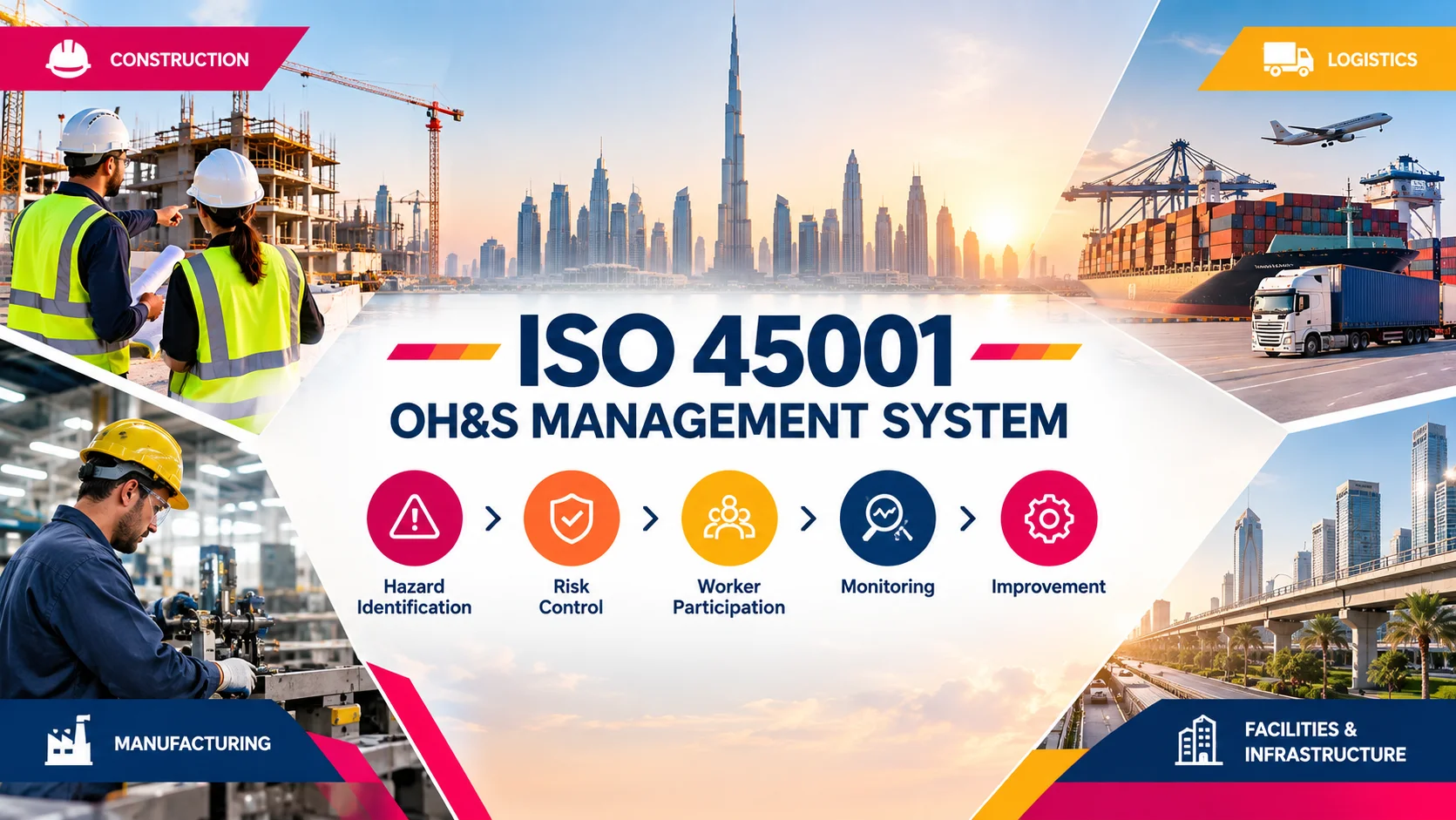
ISO 45001 is the international standard for occupational health and safety management systems. It provides a structured framework for organizations to identify hazards, manage OH&S risks, meet applicable requirements, involve workers and continually improve occupational health and safety performance.
For an auditor, however, understanding ISO 45001 is only the starting point. Professional auditing requires the ability to examine processes, interview personnel, evaluate objective evidence, identify nonconformities and communicate findings clearly.
In Dubai, employers increasingly use ISO 45001 knowledge alongside broader HSE responsibilities. Current Dubai vacancies show ISO 45001 Lead Auditor or internal-auditor knowledge appearing in HSE, QHSE, safety governance, management-system and senior HSE positions.
This guide examines the ISO 45001 auditor career path in Dubai, including what an ISO 45001 auditor does, qualifications, practical skills, job opportunities, salary benchmarks, industries, career progression and how to build experience.
Important salary note: There is no single official salary scale for “ISO 45001 Auditor” in Dubai. Public salary data combines different job titles, experience levels and responsibilities. The figures in this article are therefore market benchmarks, not guaranteed salaries.
What Is ISO 45001?
ISO 45001 is an international standard that specifies requirements for an occupational health and safety management system (OH&S MS).
Its purpose is to give organizations a systematic framework for managing occupational health and safety risks and improving OH&S performance.
Unlike an approach based only on workplace inspections or reacting after an accident, an ISO 45001 management system is designed to make occupational health and safety part of the organization’s management processes.
The standard addresses areas including:
- Organizational context
- Leadership and worker participation
- Planning
- Hazard identification
- OH&S risk assessment
- OH&S opportunities
- Legal and other requirements
- Objectives
- Competence and awareness
- Communication
- Operational planning and control
- Emergency preparedness and response
- Monitoring and measurement
- Internal auditing
- Management review
- Incident and nonconformity management
- Corrective action
- Continual improvement
ISO explains that ISO 45001 provides a framework for organizations to manage occupational health and safety risks and improve OH&S performance.
For an auditor, this means the job is not simply to determine whether safety equipment exists. The auditor must evaluate whether the organization’s OH&S management system is properly established, implemented, maintained and effective.
Why ISO 45001 Matters in Dubai?
Dubai’s economy includes industries and projects where occupational health and safety management can be operationally complex.
Construction sites, infrastructure projects, logistics operations, facilities, engineering activities, manufacturing environments and other workplaces may involve risks associated with machinery, vehicles, working at height, electrical systems, lifting operations, hazardous substances, confined spaces, heat and other workplace conditions.
The UAE’s occupational health and safety framework also places responsibilities on employers to protect workers from occupational injuries, occupational diseases, fire hazards and other workplace risks.
The UAE Ministry of Human Resources and Emiratisation states that employers must provide necessary preventive measures, communicate occupational risks to workers, provide appropriate protective measures and maintain safe working conditions.
The Ministry also requires employers to maintain occupational safety and health records covering areas such as workplace risks, preventive measures, inspections, safety permits, training, incidents and occupational diseases.
This regulatory environment is important for ISO 45001 professionals because a management system does not operate separately from applicable legal and regulatory requirements.
An ISO 45001 auditor therefore needs to understand the difference between:
ISO 45001 requirements and applicable legal and regulatory requirements.
The standard provides the management-system framework, while organizations must also determine and comply with the legal and other requirements applicable to their operations.
What Does an ISO 45001 Auditor Do?
An ISO 45001 auditor evaluates an organization’s occupational health and safety management system against defined audit criteria.
The auditor’s work can involve both documentation and actual operational conditions.
A competent auditor may review procedures and records, interview workers and managers, observe activities, examine risk assessments, evaluate controls and verify whether the organization is implementing its stated processes.
The auditor is not simply looking for paperwork.
For example, an organization may have a documented procedure for hazard identification. An auditor should consider whether hazard identification is actually being performed, whether relevant hazards are being identified, whether workers are involved where required, whether risks are evaluated appropriately and whether controls are implemented.
The same principle applies to emergency preparedness, incident investigations, competence, contractor controls, operational planning and corrective action.
A typical ISO 45001 audit may therefore involve:
Audit planning: The auditor determines the audit objectives, scope, criteria, processes, locations, timing and resources required.
Document and information review: Relevant documented information is reviewed to understand how the management system has been designed and implemented.
Interviews: The auditor speaks with management, supervisors, HSE personnel, workers, contractors and other relevant personnel.
Workplace observation: Where applicable, the auditor observes actual operations to determine whether controls described by the organization are implemented.
Evidence evaluation: The auditor evaluates objective evidence against the audit criteria.
Finding identification: Where requirements are not met, the auditor documents appropriate findings based on evidence.
Audit reporting: The auditor prepares an audit report containing the relevant findings, conclusions and other required information.
Corrective-action follow-up: Depending on the audit type and assignment, the auditor may evaluate whether corrective actions have been implemented and whether they address the underlying issue.
ISO 45001 Auditor vs HSE Officer: What Is the Difference?
These roles are related but not identical.
An HSE Officer generally has operational responsibility for supporting workplace health and safety activities.
An ISO 45001 auditor evaluates the management system against defined audit criteria.
An HSE professional may spend the day conducting inspections, monitoring site activities, investigating incidents, delivering toolbox talks or checking compliance.
An auditor may instead spend the day examining whether the organization’s overall management system provides a systematic approach to identifying hazards, controlling risks, monitoring performance and improving OH&S processes.
In practice, Dubai employers often combine these responsibilities.
A job may require an HSE professional to understand ISO 45001, conduct internal audits and support the organization’s management system at the same time.
That is why ISO 45001 auditing should be viewed as a professional capability within the broader HSE career, rather than assuming every ISO 45001 certificate leads directly to a job titled “ISO 45001 Auditor.”
What Qualifications Do You Need to Become an ISO 45001 Auditor in Dubai?
There is no single qualification that guarantees an ISO 45001 auditor position.
Employers typically evaluate a combination of education, HSE experience, ISO 45001 knowledge, audit competence and industry exposure.
Common qualifications and experience include:
- Bachelor’s degree or relevant technical qualification
- Occupational health and safety experience
- ISO 45001 Internal Auditor training
- ISO 45001 Lead Auditor training
- Practical audit experience
- Risk-assessment experience
- Incident-investigation experience
- Knowledge of workplace safety requirements
- Strong report-writing skills
- Communication and interviewing skills
- Experience in the relevant industry
For senior Dubai roles, employers may also ask for recognized HSE qualifications and substantial experience.
Current Dubai job postings illustrate this clearly. A senior HSES position advertised in Dubai asks for trained and experienced ISO standards lead-auditor capability and includes ISO 45001 among the relevant standards. Other Dubai HSE leadership vacancies identify ISO 45001 Lead Auditor qualifications alongside significant HSE management experience.
Download ISO 45001 safety audit checklist PDF
ISO 45001 Internal Auditor vs Lead Auditor
Understanding this distinction is important when planning an ISO 45001 career.
An Internal Auditor normally audits the organization’s own OH&S management system as part of its internal audit programme.
A Lead Auditor takes greater responsibility for managing or leading an audit assignment and may work with an audit team depending on the type of audit.
| ISO 45001 Internal Auditor | ISO 45001 Lead Auditor |
|---|---|
| Usually audits within the organization | May lead broader audit assignments |
| Often combines auditing with an HSE role | Auditing may be a primary responsibility |
| Develops practical audit skills | Requires stronger audit leadership capability |
| Reviews internal processes | May lead audit teams and client interactions |
| Often a starting point for audit experience | Usually requires stronger experience |
| Focuses on the organization’s OH&S system | May work across multiple organizations or sites |
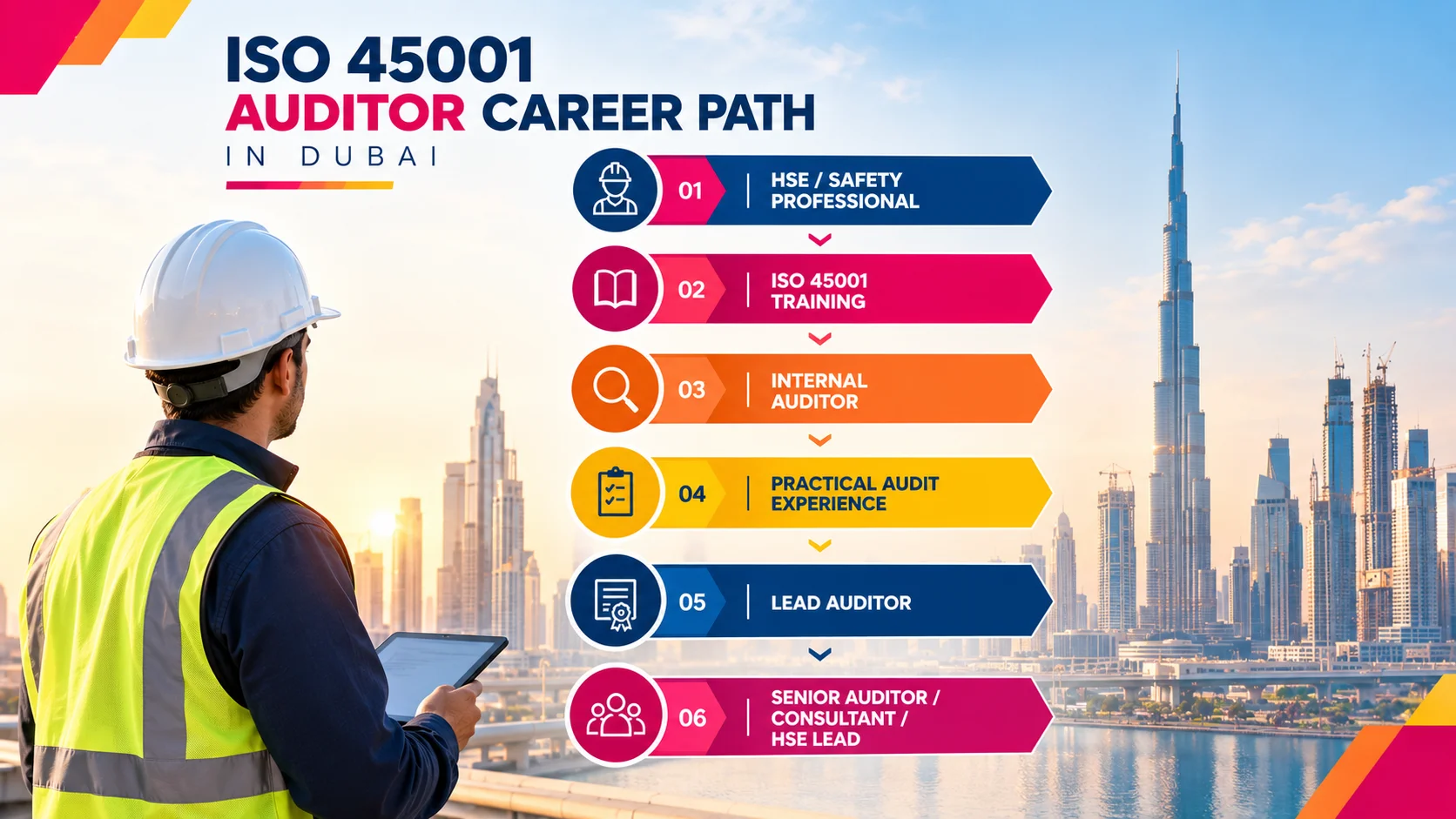
The practical career progression is often:
HSE / Safety Role → Internal Auditor → Experienced Auditor → Lead Auditor → Senior Auditor / Consultant / HSE Management
ISO 19011 provides guidance on management-system auditing, including audit principles, audit-programme management, conducting audits and evaluating the competence of people involved in auditing.
Source reference: ISO 19011 — Guidelines for auditing management systems.
ISO 45001 Auditor Salary in Dubai
Salary is one of the most searched questions around ISO 45001 careers, but it is also one of the easiest areas to misrepresent.
There is no official Dubai government salary scale specifically for “ISO 45001 Auditor.”
Public salary information can instead come from:
- Live job advertisements
- Salary platforms
- Recruiter advertisements
- Crowdsourced salary databases
- HSE job listings
- Certification-body vacancies
These sources measure different populations.
A salary advertised for an HSE Manager should not be presented as the salary of an ISO 45001 auditor.
Similarly, a salary for a general Internal Auditor should not automatically be presented as the salary of an ISO 45001 Lead Auditor.
The available Dubai evidence shows a wide range.
The salary research supporting this article identified a Dubai QHSE Management Systems Consultant / Lead Auditor vacancy at approximately AED 5,000–8,000 per month and Dubai Internal Auditor vacancies advertising up to approximately AED 12,000–13,000 per month. These positions have different responsibilities and therefore should not be treated as one salary band.
Current Dubai job-market listings also show an ISO & Process Improvement Consultant position at approximately AED 8,000–10,000 per month, although this is a broader process-improvement and ISO consulting role rather than a pure ISO 45001 auditing position.
A current Dubai HSE leadership vacancy lists AED 21,000–22,000 per month for a senior HSE Lead/Head role where ISO 45001 Lead Auditor certification is among the preferred qualifications. This is evidence of the value of ISO 45001 knowledge within a senior HSE role, but it should not be interpreted as an ISO 45001 auditor salary.
Dubai salary examples
| Dubai role / vacancy type | Reported salary | What the figure represents |
|---|---|---|
| QHSE Management Systems Consultant / Lead Auditor | AED 5,000–8,000/month | Specific job posting |
| Internal Auditor | Up to AED 12,000–13,000/month | Broader internal-audit roles |
| ISO & Process Improvement Consultant | AED 8,000–10,000/month | Broader ISO/process-improvement role |
| Senior HSE Lead / Head | AED 21,000–22,000/month | Senior HSE management role where ISO 45001 is relevant |
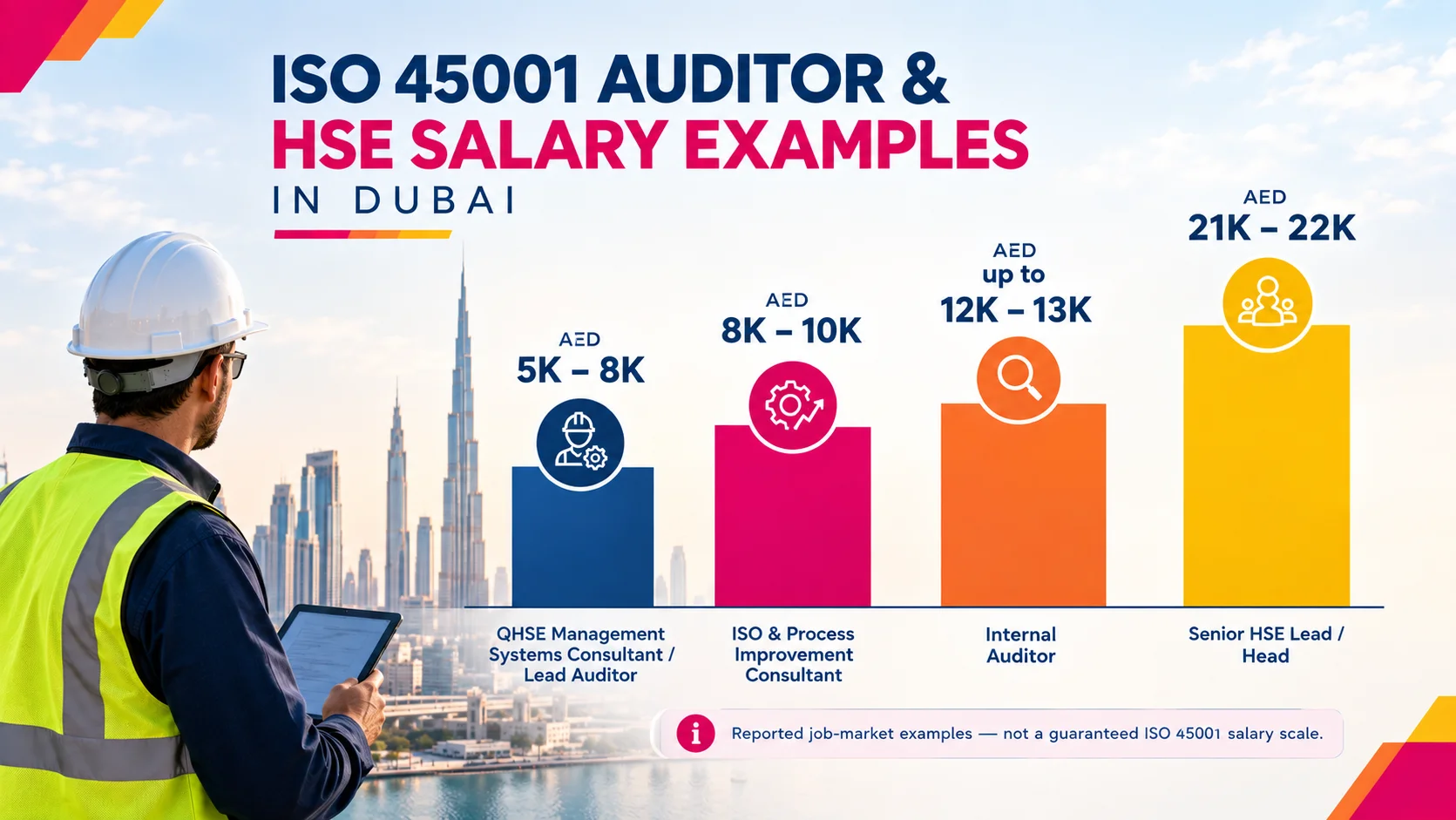
Source: Current Dubai job listings and salary data from Indeed, Glassdoor and other publicly available employment sources, reviewed September 2026. Figures are indicative market examples and not guaranteed salaries.
What Determines an ISO 45001 Auditor’s Salary in Dubai?
Experience is only one part of the salary equation.
The following factors can significantly affect compensation.
1. HSE Experience
An individual with several years of practical HSE experience may be considered for responsibilities that are not available to someone who has only completed auditor training.
Employers may value experience in:
- Construction
- Oil and gas
- Engineering
- Manufacturing
- Logistics
- Facilities management
- Infrastructure
- Ports and terminals
- Energy
- High-risk industrial operations
Current Dubai vacancies demonstrate this relationship between ISO 45001 knowledge and broader HSE experience.
For example, a current Dubai senior HSE role involving ISO 45001 requires substantial HSE experience alongside lead-auditor capability.
2. Audit Experience
Completing an ISO 45001 Lead Auditor course is different from having conducted real audits.
An experienced auditor should be able to:
- Prepare an audit plan
- Develop audit questions
- Interview workers and managers
- Evaluate objective evidence
- Identify nonconformities
- Write clear findings
- Conduct opening and closing meetings
- Prepare audit reports
- Evaluate corrective actions
- These are practical skills.
The more responsibility an auditor can demonstrate, the broader the range of roles that may become available.
3. Industry
The industry in which an auditor works can influence both responsibility and compensation.
A professional auditing a low-risk office environment may encounter a very different risk profile from an auditor working around:
- Heavy machinery
- Construction activities
- Lifting operations
- Oil and gas facilities
- Chemical handling
- Industrial manufacturing
- Ports
- Warehouses
- Large infrastructure projects
This is why industry knowledge is valuable.
4. Employer Type
An ISO 45001 professional can work in several environments:
Internal organization
The auditor works within an organization and supports its OH&S management system.
Consultancy
The professional supports multiple organizations with implementation, gap assessments, internal audits or management-system improvement.
Certification body
The auditor conducts third-party certification audits according to the certification body’s processes and applicable accreditation requirements.
HSE management
The professional uses ISO 45001 knowledge as part of a broader HSE management role.
The salary structure can differ significantly between these employment models.
5. Seniority
A junior HSE professional with ISO 45001 knowledge and a senior HSE manager with ISO 45001 Lead Auditor training are not equivalent profiles.
At senior levels, employers may expect:
- Leadership
- Team management
- Audit-programme management
- Regulatory knowledge
- Incident investigation
- Risk management
- Contractor management
- Performance analysis
- Management reporting
- Strategic planning
Therefore, ISO 45001 becomes one component of a larger professional skill set.
Which Industries in Dubai Hire ISO 45001 Professionals?
ISO 45001 knowledge is relevant across industries with structured occupational health and safety systems.
Construction & Infrastructure
Professionals may work on risk management, contractor controls, internal audits and safety performance.
Oil & Gas & Energy
ISO 45001 knowledge complements HSE experience in high-risk industrial environments.
Manufacturing
Key areas include machinery safety, chemicals, maintenance, electrical hazards and operational risks.
Logistics & Warehousing
Roles can involve vehicle safety, lifting equipment, storage systems and contractor activities.
Facilities Management
Professionals may support contractor management, emergency preparedness, maintenance and workplace safety.
Ports & Terminals
Port operations involve cargo handling, vehicles, lifting and complex safety risks. Some Dubai HSE roles also reference ISO 45001 audit preparation.
What Skills Should an ISO 45001 Auditor Have?
An effective auditor needs more than clause knowledge. Key skills include:
- Hazard identification
- Risk assessment
- Operational controls
- Worker participation
- Legal and other requirements
- Incident investigation
- Emergency preparedness
- Audit interviewing
- Report writing
The goal is to connect:
Requirement → Process → Evidence → Conclusion
This is the foundation of evidence-based auditing.
Frequently Asked Questions
What is the ISO 45001 auditor salary in Dubai?
There is no single official salary. Available job-market examples vary significantly by role, experience and responsibility, so they should be treated as market examples rather than one salary range.
Which industries need ISO 45001 professionals?
Relevant sectors include construction, energy, manufacturing, logistics, facilities management, ports, transportation and other organizations with structured OH&S systems.
What are the 7 main areas of ISO 45001?
The standard is commonly structured around Context, Leadership and Worker Participation, Planning, Support, Operation, Performance Evaluation, and Improvement.
Is ISO 45001 useful for HSE professionals?
Yes. ISO 45001 knowledge can complement HSE experience by adding management-system, auditing and compliance skills.
Can a safety officer become an ISO 45001 auditor?
Yes. Safety professionals can build on their existing knowledge of hazards, risk assessment, incident investigation and workplace controls by developing ISO 45001 auditing skills.
Final Thoughts
An ISO 45001 career is built on more than certification.
The strongest profile combines:
HSE Experience → ISO 45001 Knowledge → Internal Auditing → Practical Audit Experience → Lead Auditor Capability → Senior HSE / Audit Roles
ISO 45001 knowledge can support careers across several HSE and management-system positions in Dubai. The opportunity is therefore broader than the title “ISO 45001 Auditor.”